漫畫/插畫
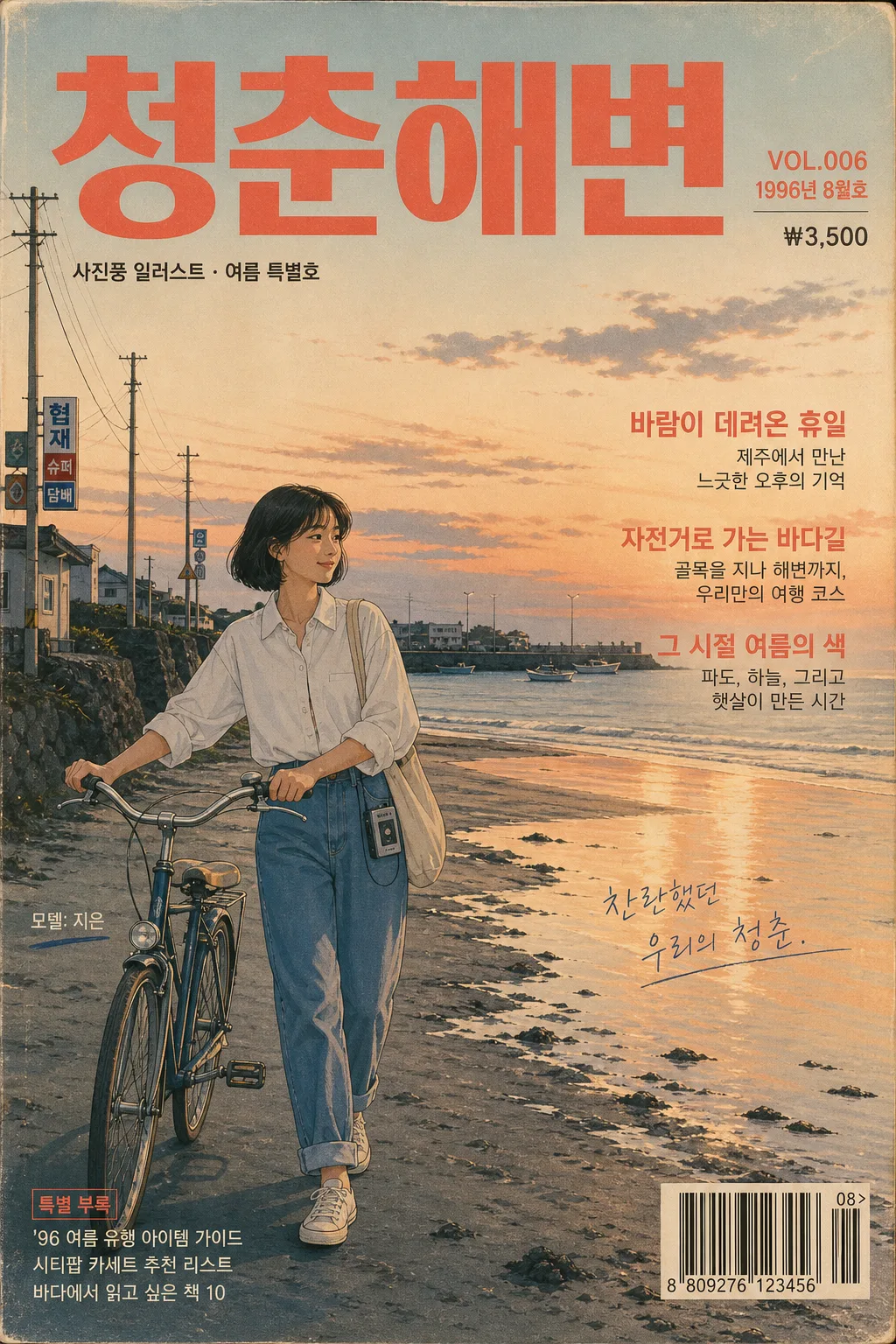
한국 90년대 빈티지 매거진 일러스트
1990년대 한국 향수 + 일본 시티팝 감성을 섞은 빈티지 매거진 일러스트. 인스타 / 블로그 헤더 / 굿즈 컨셉용.
한국 90년대 빈티지 매거진 일러스트摘要
這是用來製作漫畫/插畫內容的 ChatGPT 圖像提示詞,已整理主題、背景、風格與構圖,方便快速調整。
相關關鍵字: 한국 90년대 빈티지 매거진 일러스트, 한국 90년대 빈티지 매거진 일러스트 프롬프트, 漫畫/插畫 프롬프트, 漫畫/插畫 AI 이미지 프롬프트, ChatGPT 이미지 프롬프트, AI 이미지 생성 프롬프트, AI 프롬프트, 이미지 프롬프트
한국 90년대 빈티지 매거진 일러스트使用方式
保留原始結構並替換主體、背景、色彩或構圖,即可延伸出不同版本。
- 保留核心主體,並依品牌、季節或平台調整色彩與背景。
- 如果畫面太複雜,請減少背景元素並具體描述主體、構圖與光線。
- 複製後可要求 ChatGPT 配合平台、長寬比或文字需求調整。
提示詞原文
[Input]
- language: Korean
- output_size: 1024x1536

[Purpose]
90s Korean vintage magazine illustration, vertical editorial magazine cover for nostalgic lifestyle art.\nPixiv subculture-inspired flat illustration with a cinematic coastal landscape emphasis, enriched with realistic magazine-cover publishing details, natural seaside atmosphere, and period-specific Korean youth-culture styling.

[Composition]
- {장소} is the primary setting, presented as a lived-in coastal location with shoreline depth, reflective water, low horizon, weathered beach foreground, distant seawall, small street lamps, utility poles, and subtle signs of everyday 1990s Korean seaside life.
- {피사체} is placed in the left third, slightly below center, fully visible with a coherent bicycle silhouette, relaxed walking pose, readable clothing folds, and a gentle editorial presence against the sea and sky.
- {시대 분위기} should be communicated through wardrobe, color blocking, printed-magazine typography, cover-line hierarchy, soft retro accessories, and the overall faded 1990s Korean lifestyle atmosphere.
- Background treatment: shoreline, waterline, and sky remain cleanly layered, but include natural details such as foam traces, wet-sand reflections, distant boats, telephone wires, small beach debris, faded pavement markings, and sunset cloud streaks.
- Framing: cinematic wide-shot feeling inside a vertical magazine cover, with the subject grounded by the beach foreground, the horizon line kept low, and cover text arranged around the landscape without hiding the face or bicycle.

[3. CORE STRUCTURE]
1) Magazine cover base — Build the full image as a 1990s Korean monthly magazine cover with masthead, issue number, date label, barcode area, feature headline blurbs, small spine/credit text, model-name credit, and lightly aged printed-paper finish.
2) Background base — Build {장소} as a nostalgic coastal scene with an expansive sky, a thin horizon line, calm reflective sea, wet sand, distant seawall, small fishing boats, utility poles, and real environmental texture rendered in flat shapes and crisp linework.
3) Subject block — Place {피사체} in the left third, fully visible, with clear bicycle outline, readable clothing folds, natural walking posture, correct wheel geometry, and believable contact shadows on the sand or pavement.
4) Era atmosphere — Infuse {시대 분위기} through subdued pastel contrast, 90s casual wardrobe styling, slightly faded print registration, soft beach signage, analog-magazine layout, and small nostalgic details such as a cassette-player strap, windbreaker texture, or canvas tote if appropriate.
5) Editorial content layer — Add short Korean cover lines that feel like a real lifestyle magazine: a masthead at the top, VOL/date label, 2-3 feature blurbs, a model-name credit near the subject, a barcode at bottom right, and tiny publisher/spine text along one edge.
6) Surface treatment — Apply subtle film grain, paper fiber, halftone dot texture in shadow areas, slight ink misregistration, sun-faded edges, and hand-drawn imperfections while keeping the illustration polished and cover-ready.

[4. STYLE RULES]
- Typography: render Korean magazine-cover text accurately, using bold 1990s editorial lettering for the masthead and short headline blurbs; integrate text with the illustration like a real printed cover rather than floating UI labels.
- Required cover elements: large masthead text '청춘해변', issue label 'VOL.006', date label '1996년 8월호', price '₩3,500', model credit '모델: 지은', small credit text '사진풍 일러스트 · 여름 특별호', and a barcode area with small numbers at the lower right.
- Feature headline blurbs: include 2-3 short Korean blurbs such as '바람이 데려온 휴일', '자전거로 가는 바다길', '그 시절 여름의 색', arranged along the right side and lower third in a natural magazine-cover hierarchy.
- Color palette: cream #F4E9D8, coral #E98A7A, dusty teal #6F9A9A, muted sky blue #AFC4D8, soft sand #D8C6A6, charcoal linework #2D2A28.
- Border/shadow: use a soft print-like edge fade, faint fold or scan-edge wear, gentle paper shadow at the perimeter, and subtle atmospheric separation between layers.
- Rendering: flat color blocking, crisp contour lines, low-contrast matte finish, visible paper grain, occasional halftone shading, and slight ink misregistration feel without making the image look damaged.

[5. VISUAL STYLE]
- Camera / lens: 35mm documentary wide shot equivalent, vertical editorial framing, low horizon placement, no shallow depth-of-field effect.
- Lighting: late sunset golden-hour light from frame right, gentle backlit rim on hair and shoulders, warm reflections on bicycle metal, soft ambient fill from the sky, and long subtle shadows across the beach foreground.
- Color grade: faded 1990s print palette with warm cream highlights, coral accents, muted teal shadows, slightly washed sky blue midtones, and realistic sun-aged magazine ink density.
- Print realism: emulate a scanned vintage Korean magazine cover with paper fibers, mild corner wear, light halftone texture, tiny registration offsets around charcoal linework, and believable ink absorption on cream stock.

[6. MOOD]
Korean 90s nostalgia mixed with Japanese city pop editorial art — like a summer lifestyle magazine found in an old bookstore, combining Pixiv subculture illustration, gentle seaside melancholy, and warm analog print charm.

[7. CRITICAL]
- Korean text accuracy: all visible Korean text must be clean and legible, especially '청춘해변', 'VOL.006', '1996년 8월호', '₩3,500', '모델: 지은', '바람이 데려온 휴일', '자전거로 가는 바다길', '그 시절 여름의 색', and '사진풍 일러스트 · 여름 특별호'.
- Keep all text short, cover-like, and properly aligned; do not generate garbled Hangul, random pseudo-Korean, or unreadable character clusters.
- Anatomy/layout invariants when relevant: the bicycle must be anatomically coherent and fully readable; keep {피사체} in the left third; no cropped face, no distorted wheels, no duplicated limbs, and no extra main character competing with the subject.
- Magazine-cover realism: include issue number, date label, barcode area, 2-3 Korean feature blurbs, small spine/credit text, and model-name credit while preserving the coastal illustration as the hero image.

[8. 🚫 PROHIBITED]
- Fake official seals / certifications
- Broken Korean characters
- Celebrity composites / unauthorized likeness