Infographics/Guides
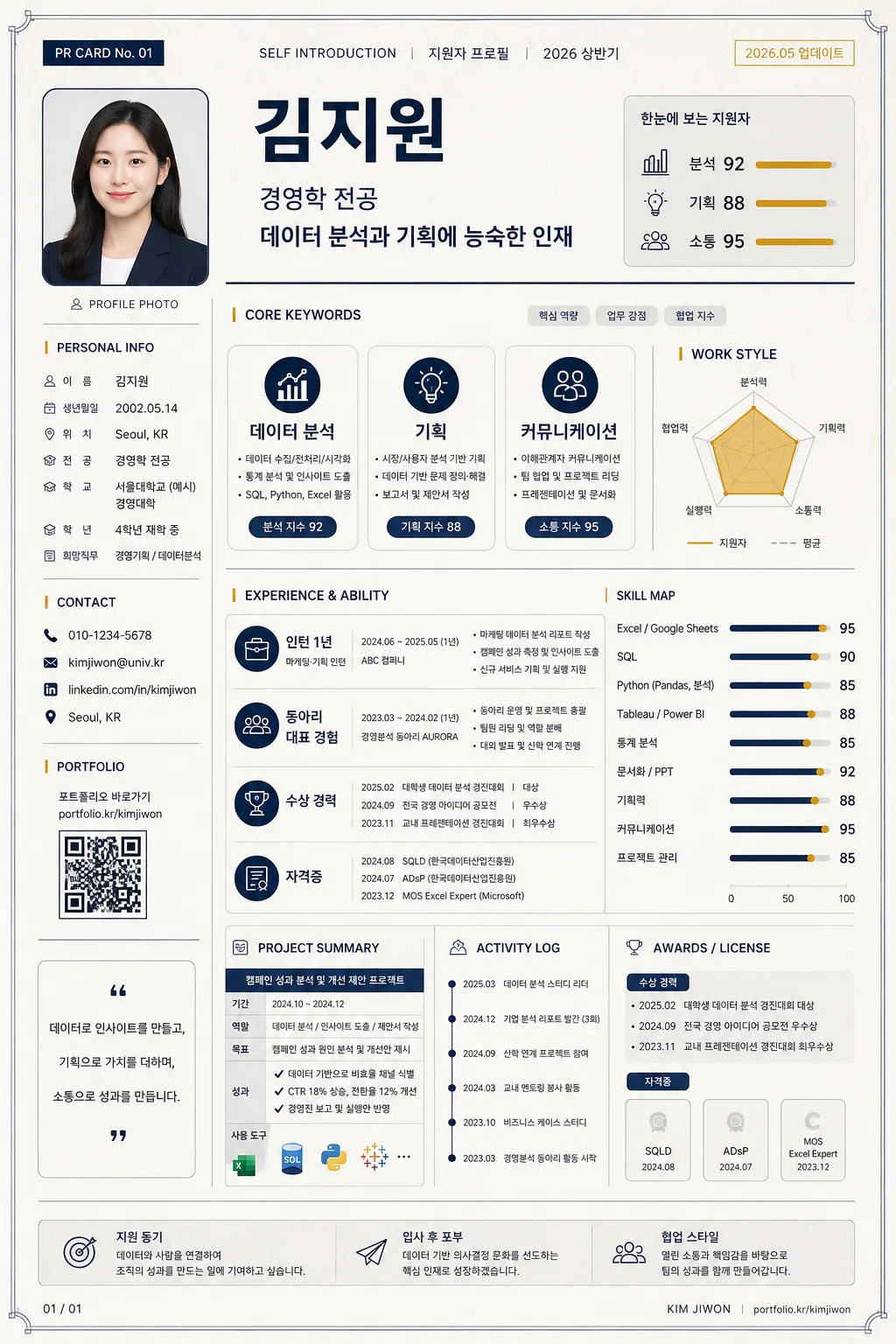
한국 자기소개서 한 페이지 PR 카드
취업·이력서용 한 페이지 자기 PR 카드. 이름·전공·경력·핵심 키워드 입력하면 깔끔한 한 장 인포카드로 변환.
한국 자기소개서 한 페이지 PR 카드 summary
Copy this ChatGPT image prompt to create Infographics/Guides results. Its subject, background, style, and composition are organized for quick iteration.
Related keywords: 한국 자기소개서 한 페이지 PR 카드, 한국 자기소개서 한 페이지 PR 카드 프롬프트, Infographics/Guides 프롬프트, Infographics/Guides AI 이미지 프롬프트, ChatGPT 이미지 프롬프트, AI 이미지 생성 프롬프트, AI 프롬프트, 이미지 프롬프트
How to use 한국 자기소개서 한 페이지 PR 카드
Keep the prompt structure and swap the subject, background, palette, or composition to create new variations.
- Keep the main subject and adjust the palette and background for your brand, season, or channel.
- If the result feels busy, simplify the background and make the subject, composition, and lighting more specific.
- After copying, ask ChatGPT to adapt it for your platform, aspect ratio, or text requirements.
Original prompt
[Input]
- language: Korean
- output_size: 1024x1536

[Purpose]
Korean self-introduction PR card, one-page corporate interview handout, information-dense grid layout.
Realistic, print-ready personal branding sheet for job applicants, mixing Korean and English typography in a polished editorial HR profile style, with practical application details, skill metrics, badges, and a date-stamped portfolio-card feeling.

[Composition]
- Vertical one-page layout with a structured grid: top identity header 20%, middle keyword and skill showcase 35%, lower experience infographic 30%, side portrait and contact rail 15%.
- {사진 스타일} is placed in a narrow side column or upper corner as a small ID-style portrait, framed neatly with rounded-rectangle crop, thin stroke, and a subtle paper-card shadow.
- Background is off-white / light gray paper tone with fine realistic paper texture, faint registration marks, tiny section labels, and layered card panels that make the sheet feel like a professionally printed recruiting profile.
- Use {이름}, {전공 및 한 줄 소개}, {핵심 키워드}, {경력 및 역량}, {추가 정보}, {디자인 색상} placeholders throughout the layout.
- Add realistic PR-card metadata: small issue-like label “PR CARD No. 01”, date stamp “2026.05 업데이트”, location label “Seoul, KR”, portfolio/contact micro line, and a small QR-style portfolio block as a graphic element.
- The layout should look submitted to a Korean university career center or corporate interview panel: aligned modules, readable hierarchy, printed paper realism, and credible applicant information density.

[3. CORE STRUCTURE]
1) Top header band: Place {이름} in the largest type, with {전공 및 한 줄 소개} directly beneath in smaller subheadline text. Add small English/Korean micro labels such as “SELF INTRODUCTION”, “지원자 프로필”, “2026 상반기”, and a thin separator line below.
2) Portrait zone: Show {사진 스타일} as a small clean portrait, cropped tightly like a professional profile photo, with neutral background integration, rounded frame, thin navy border, and a caption label “PROFILE PHOTO”.
3) Core keywords zone: Visualize {핵심 키워드} as 3–4 bold keyword blocks, badges, or pill-like labels with tiny line icons beside each word. Add small supporting tags like “핵심 역량”, “업무 강점”, “협업 지수” to make the center feel like a real candidate snapshot.
4) Experience / ability zone: Present {경력 및 역량} and {추가 정보} as compact infographic modules using progress bars, line icons, small charts, checkmarks, and timeline-like rows. Include realistic labels such as “EXPERIENCE”, “SKILL MAP”, “PROJECT SUMMARY”, “ACTIVITY LOG”, and “AWARDS / LICENSE”.
5) Supporting details: Add concise micro-labels, separators, dotted guide lines, tiny page-number text “01 / 01”, portfolio URL placeholder text like “portfolio.kr/kimjiwon”, and a non-functional QR-style square. Use these details to connect sections while preserving a formal corporate portfolio look.
6) Profile / award-card decoration: Add certificate-inspired corner ornaments, thin rule lines, small skill badges, a date stamp, and a compact stats strip such as “분석 92”, “기획 88”, “소통 95”; these must look decorative and personal-branding oriented, not like an official certification.

[4. STYLE RULES]
- Typography: Use clean sans-serif Korean and English pairing such as Pretendard, Noto Sans KR, or SUIT; name weight 700–800, subheadline 400–500, body 400–600, size hierarchy clearly separated.
- Color palette: Use the exact set from {디자인 색상} with navy as primary, light gray as background or panel base, and mustard as accent; optional near-black text and warm paper-white panels.
- Border/shadow: Thin 1px dividers, rounded cards with 8–12px radius, subtle layered paper shadows of 0px 4px 12px at 12–15% opacity for key panels, and fine mustard accent rules.
- Use strict grid alignment, consistent padding, formal icon style, and editorial spacing so the page remains credible as a printed interview handout.
- Add realistic print details: tiny footer credit line, small crop-mark-like accents, section numbering, light paper grain, and slight ink texture on dark navy text.

[5. VISUAL STYLE]
- Camera / lens: Studio portrait look, Canon EOS R5 with 85mm f/1.8 portrait framing for {사진 스타일}, sharp facial detail, neutral depth separation.
- Lighting: Soft studio key light from upper-left at 45° with gentle fill from right, controlled shadow, balanced for a corporate headshot feel.
- Color grade: Cool navy + light gray base with mustard accent, slightly desaturated, clean editorial print finish.
- Rendering: Realistic printed A4-like card surface, crisp typography, subtle paper fibers, accurate Korean text, and believable ink contrast.

[6. MOOD]
Corporate personal branding sheet — modern Korean recruiting portfolio aesthetic, like a polished university career center PR card with editorial magazine clarity, practical HR readability, and a confident applicant profile tone.

[7. CRITICAL]
- Korean text accuracy: 반드시 정확히 렌더링할 문구 — “김지원”, “경영학 전공, 데이터 분석과 기획에 능숙한 인재”, “데이터 분석, 기획, 커뮤니케이션”, “인턴 1년, 동아리 대표 경험”, “수상 경력, 자격증”.
- Additional Korean microcopy may include: “지원자 프로필”, “핵심 역량”, “업무 강점”, “경험 요약”, “프로젝트”, “활동 기록”, “2026.05 업데이트”, “서울”, “포트폴리오”, “면접용 PR 카드”, “01 / 01”.
- The page must feel like a single cohesive one-page self-introduction card, not a poster or brochure.
- Portrait must be a small formal ID-style photo, not a full-body lifestyle image.
- Keep all infographic labels aligned and readable, with no overlapping text.

[8. 🚫 PROHIBITED]
- Fake official seals / certifications
- Broken Korean characters
- Celebrity composites / unauthorized likeness