個人檔案/頭像
따뜻한 인터뷰 인물 일러스트
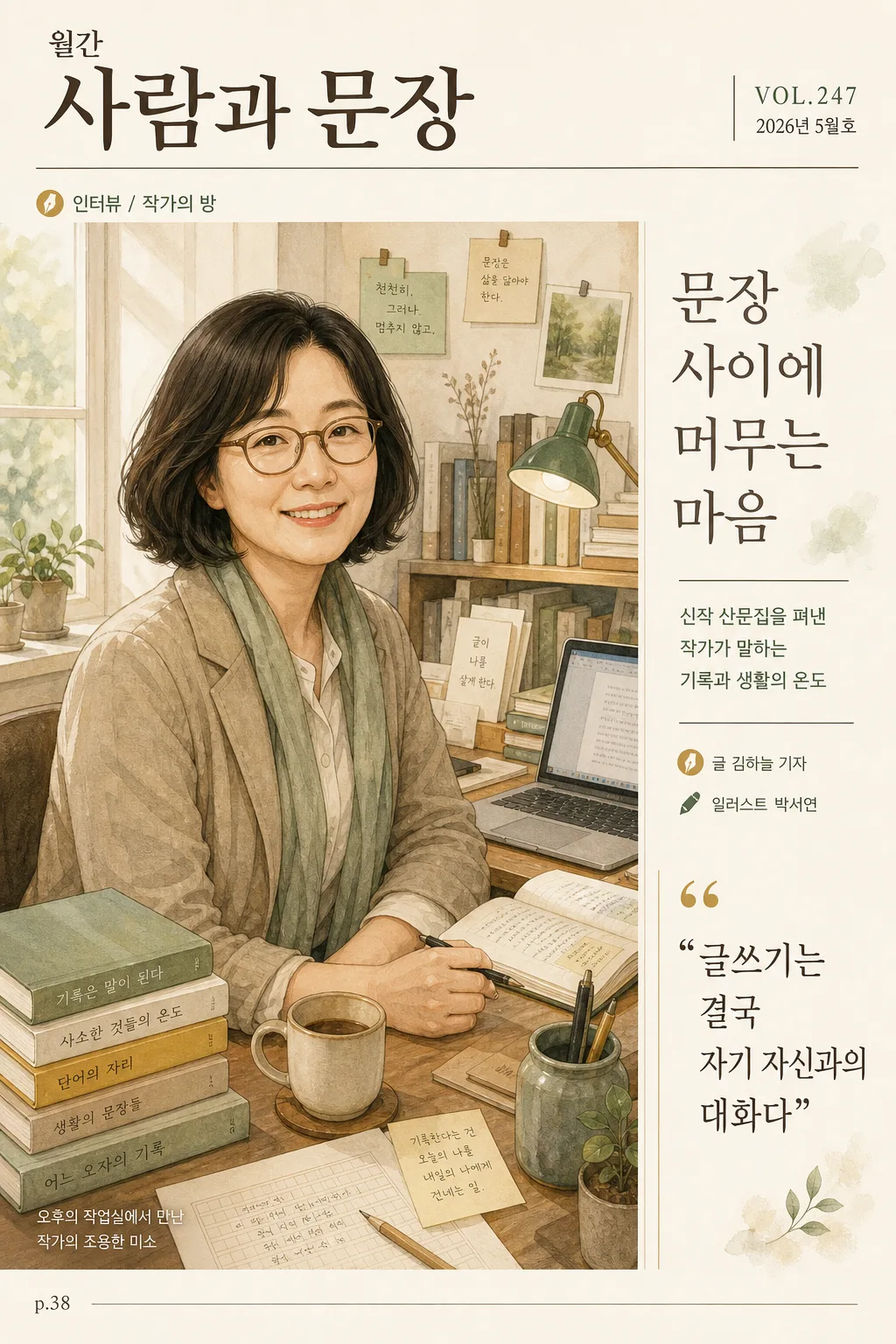
인터뷰 기사용 인물 일러스트 — 헤드샷·반신 일러스트 + 인터뷰 한 줄 인용. 인물 묘사 입력하면 매거진 인터뷰 일러스트 톤으로 변환.
따뜻한 인터뷰 인물 일러스트摘要
這是用來製作個人檔案/頭像內容的 ChatGPT 圖像提示詞,已整理主題、背景、風格與構圖,方便快速調整。
相關關鍵字: 따뜻한 인터뷰 인물 일러스트, 따뜻한 인터뷰 인물 일러스트 프롬프트, 個人檔案/頭像 프롬프트, 個人檔案/頭像 AI 이미지 프롬프트, ChatGPT 이미지 프롬프트, AI 이미지 생성 프롬프트, AI 프롬프트, 이미지 프롬프트
따뜻한 인터뷰 인물 일러스트使用方式
保留原始結構並替換主體、背景、色彩或構圖,即可延伸出不同版本。
- 保留核心主體,並依品牌、季節或平台調整色彩與背景。
- 如果畫面太複雜,請減少背景元素並具體描述主體、構圖與光線。
- 複製後可要求 ChatGPT 配合平台、長寬比或文字需求調整。
提示詞原文
[Input]
- language: Korean
- output_size: 1024x1536

[Purpose]
Korean magazine/newspaper interview portrait illustration, vertical 2:3 editorial feature image with a warm, approachable tone.
Designed as a realistic article opener for a culture magazine profile, combining a softly stylized portrait with believable publication metadata, pull quote, caption, and interview layout elements.

[Composition]
- Main subject: {인물 정보} placed slightly off-center, occupying about 55% of the frame height, with a gentle 3/4 angle, relaxed posture, and direct but soft eye contact.
- Composition type: {컷 종류} crop, head, shoulders, torso, and natural hand gesture readable as an interview portrait; include posture details that suggest the person is mid-conversation.
- Background treatment: {배경} arranged as a lived-in writer’s workspace with books, manuscript pages, laptop, coffee cup, sticky notes, desk lamp, ceramic pen cup, and soft window shapes that support the interview theme.
- Editorial layout: place {매체명}, {호수}, {발행일}, {섹션명}, {인터뷰 제목}, {부제}, {기자명}, {크레딧}, {페이지 번호}, and {짧은 캡션} as believable magazine/newspaper design elements around the portrait.
- Quote placement: {인용구} set as a prominent pull quote in a clean side column or lower-right feature box, paired with a small decorative quote mark, thin column rule, and warm accent color.

[Core Structure]
1. Portrait block (center-left 55%): depict {인물 정보} with realistic facial structure, soft smile, natural skin undertones, glasses reflections, short bob hair texture, and calm eye contact; use {일러스트 스타일} to preserve likeness while keeping a warm editorial illustration feel.
2. Outfit and pose layer: dress the subject in interview-appropriate attire with subtle fabric folds, a cardigan, blouse, linen jacket, or scarf detail; show one hand resting near a notebook or mug if it helps the scene feel candid and conversational.
3. Workspace layer: build {배경} with a desk surface, stacked books with Korean spine text, open notebook, laptop displaying vague document lines, coffee cup, pencil marks, small plant, pinned memo cards, and soft paper textures that make the space feel real and inhabited.
4. Publication header: at the top, render {매체명} as the main masthead, followed by {호수} and {발행일}; add a small section label {섹션명} and a thin editorial divider line.
5. Article text system: set {인터뷰 제목} as the primary Korean headline, {부제} as a smaller subhead, {기자명} and {크레딧} as byline/credit text, {페이지 번호} near the bottom edge, and {짧은 캡션} close to the portrait or desk detail.
6. Quote area: render {인용구} as the main pull quote in quotation marks, large enough to be readable, with balanced line breaks and a refined Korean editorial font.
7. Final polish: add soft paper grain, watercolor wash transitions, gentle vignette warmth, small layout ornaments such as a column rule, page folio, and caption marker so the image feels like a finished magazine interview spread rather than a plain portrait.

[Style Rules]
- Typography: use clean Korean editorial sans-serif such as Pretendard or Noto Sans KR for metadata and caption, with a softer serif-style Korean display treatment for the main quote if suitable; maintain clear hierarchy between masthead, headline, quote, byline, and page number.
- Color palette: build the scene from {색감}, anchored by warm beige #D8C6A8, mustard #C8A04A, sage #A8B49A, creamy off-white #F5F0E6, muted ink brown #4B3F35, and natural skin tones with soft rosy undertones.
- Line and shading: use refined, slightly softened contour lines, muted shadow edges, smooth watercolor-like fills, subtle hatching on books and paper, and gentle tonal variation in hair, glasses, fabric, and desk objects.
- Editorial decoration: include a thin vertical rule, small page folio, issue/date line, caption marker, and understated quote-mark graphic; keep all decoration integrated with the magazine interview concept.
- Print realism: allow paper grain, slight ink texture, soft registration-like color overlap, and tactile illustration texture while keeping facial features and Korean text clean.

[Visual Style]
- Camera / lens: editorial portrait framing inspired by an 85mm f/1.8 portrait lens with a shallow depth-of-field feel, even though the final result is an illustration.
- Lighting: soft window light from upper-left at roughly 45°, with a faint bounce fill from lower-right to keep the face bright and approachable.
- Color grade: warm cream + beige + sage with muted mustard accents, slightly lifted shadows, and gentle contrast similar to a Kinfolk-style print spread.

[Mood]
Premium interview feature illustration — calm, thoughtful, intimate, and magazine-polished, with the restrained warmth of a Korean culture magazine profile and the lived-in sincerity of a writer’s studio.

[Critical]
- Korean text accuracy: the pull quote must appear exactly as {인용구}, including the surrounding quotation marks.
- Required rendered Korean editorial text: show {매체명}, {호수}, {발행일}, {섹션명}, {인터뷰 제목}, {부제}, {기자명}, {크레딧}, {페이지 번호}, and {짧은 캡션} clearly enough to read.
- Portrait accuracy: keep the subject clearly readable as {인물 정보}, with glasses, short bob hair, and a warm smile matching the provided description.
- Layout invariant: preserve a vertical Korean interview-article structure where the portrait is the emotional focus and the pull quote, headline, byline, caption, issue/date, and page folio feel like authentic publication elements.

[8. 🚫 PROHIBITED]
- Fake official seals / certifications
- Broken Korean characters
- Celebrity composites or unauthorized famous-person likeness blending