프로필/아바타
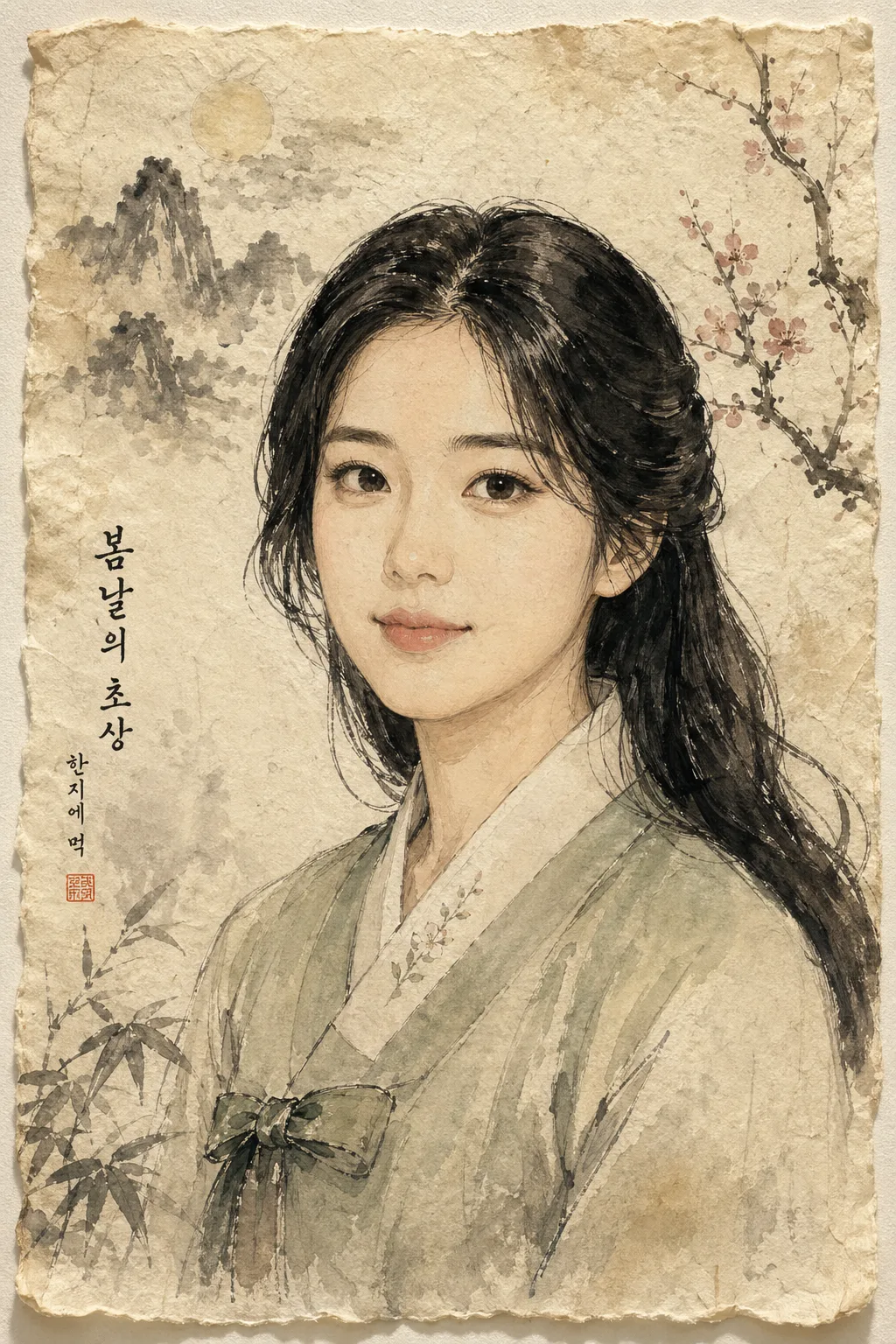
동양화 한지 초상화
인물 사진 첨부하면 한지 위에 그린 동양화 초상 스타일로 변환. 얼굴 구조·특징 유지하되 사진 질감 X — 먹·붓·한지 무드.
동양화 한지 초상화 검색 요약
동양화 한지 초상화은 프로필/아바타 결과물을 만들 때 바로 복사해 활용할 수 있는 ChatGPT 이미지 프롬프트입니다. 주제, 배경, 스타일, 구도 조건을 함께 담아 빠르게 시안을 만들 수 있도록 구성했습니다.
관련 키워드: 동양화 한지 초상화, 동양화 한지 초상화 프롬프트, 프로필/아바타 프롬프트, 프로필/아바타 AI 이미지 프롬프트, ChatGPT 이미지 프롬프트, AI 이미지 생성 프롬프트, AI 프롬프트, 이미지 프롬프트
동양화 한지 초상화 활용 포인트
원본 구조를 유지하면서 피사체, 배경, 색감, 구도를 바꿔 다양한 시안으로 확장할 수 있습니다.
- 핵심 소재는 유지하고 브랜드, 계절, 채널 목적에 맞는 색감과 배경을 바꿔보세요.
- 결과가 산만하면 배경 요소를 줄이고 피사체, 구도, 조명 조건을 구체화하세요.
- 복사한 뒤 ChatGPT에서 플랫폼, 화면 비율, 텍스트 포함 여부를 추가로 요청할 수 있습니다.
프롬프트 원문
[Input]
- reference_image: {참고 이미지}
- language: Korean
- output_size: 1024x1536

[Purpose]
Korean traditional ink-and-hanji portrait reinterpretation, vertical fine-art image for a gallery print, tea-house wall piece, or handcrafted portrait commission.
Identity-preserving portrait with visible brush texture, paper grain, layered ink diffusion, restrained classical color accents, and authentic details of a finished artwork on hanji.

[Composition]
- Primary subject: the face and upper torso occupy about 60% of the frame, with the head slightly above center and shoulders tapering naturally downward.
- Framing: chest-up portrait, slight 3/4 angle or frontal pose, with the hanji sheet, fiber edges, deckled corners, and slight paper waviness visible as part of the artwork.
- Background treatment: warm cream hanji texture with softly integrated plum blossom, chrysanthemum, bamboo, misty mountain, moon, cloud, or ink-wash landscape motifs behind and around the figure, using {배경·소품} as the main environmental cue.
- Include authentic art-object details: a small brushed Korean inscription near one side, a muted red artist seal accent, faint pigment blooms, uneven ink absorption, hand-mounted paper texture, and subtle tonal stains that make the piece feel physically painted rather than digitally flat.
- Use {원본 보존} for facial structure, expression, and identity retention; {화풍} for the rendering approach; {배경·소품}, {컬러 톤}, {의상}, {구도} for the final visual direction.
- The composition should feel like a real traditional portrait artwork photographed or scanned from hanji: refined, layered, tactile, and complete, with natural surrounding motifs supporting the sitter’s presence.

[3. CORE STRUCTURE]
1. Face rendering layer: recreate the subject from {참고 이미지} with exact identity preservation, using traditional ink wash contours, soft watercolor-like filling, pigment granulation, and brushstroke edges that feel hand-painted on absorbent hanji.
2. Hair and facial definition: emphasize eyes, brows, nose bridge, lips, jawline, and hair silhouette with refined black ink linework; keep contours elegant and slightly softened, as in a museum-grade Korean portrait reinterpreted through {화풍}.
3. Clothing layer: depict {의상} with simplified fold structures, muted textile folds, subtle collar details, fabric seams, knot or ribbon accents where appropriate, and traditional brush treatment rather than glossy realistic fabric sheen.
4. Background layer: place {배경·소품} behind and beside the subject as integrated ink motifs — for example a low ink landscape, bamboo leaves, plum branches, chrysanthemum petals, tea utensils, folding-screen suggestion, or moonlit wash — balanced so the face remains the clear focal point.
5. Color application: base the palette on {컬러 톤}, keeping saturation restrained while allowing paper fiber, ink diffusion, layered wash marks, pigment pooling, and dry-brush streaks to create visual richness.
6. Composition finish: apply {구도} with naturally uneven hanji edges, a faint mount-shadow or paper overlap, a small red artist seal-like accent, and a hand-brushed inscription that feels like part of the traditional artwork.

[4. STYLE RULES]
- Typography: if text appears, render it only as hand-brushed Korean calligraphy with soft ink bleed and natural brush pressure, not digital lettering. Use short inscription-style text such as “봄날의 초상”, “한지에 먹”, or “오월의 얼굴”.
- Color palette: use off-white hanji #F3EBDD, ink black #1B1B1B, warm earth brown #8B6B4E, ochre #C79A5A, sage green #8FA07A, muted red seal #B33A32, with occasional pale mineral blue-gray or faded persimmon pigment if it supports {컬러 톤}.
- Surface and mounting: show tactile hanji fibers, deckled edges, slight buckling, faint mounting lines, pigment stains, dry-brush marks, and red seal ink pressed into paper texture; avoid a glossy poster finish.
- Decorative balance: motifs and calligraphy should be integrated into the traditional painting language, giving the portrait the richness of a completed commissioned artwork rather than a plain isolated head study.

[5. VISUAL STYLE]
- Camera / lens: full-frame portrait reference translated into a painterly composition, equivalent to an 85mm f/1.8 portrait framing with photographic depth cues softened into flat paper space.
- Lighting: diffuse overcast window light from upper-left, gentle fill from front, no harsh directional shadow; pigment, ink density, and paper texture should carry the volume.
- Color grade: muted museum palette with warm cream, earthy ochre, gray-black ink, restrained sage-green accents, and aged hanji warmth, similar to a refined Korean traditional art reproduction photographed under soft gallery light.

[6. MOOD]
Contemporary museum-piece reinterpretation of Korean court-portrait sensibility — refined, calm, tactile, and archival, with the dignity of a handcrafted hanji portrait displayed in a quiet tea room or small gallery.

[7. CRITICAL]
- Korean text accuracy: any visible Korean calligraphy must be clean and legible, limited to short inscription-style phrases such as “봄날의 초상”, “한지에 먹”, “오월의 얼굴”, or a simple artist mark; do not generate random or malformed Korean.
- Identity preservation: the face must remain clearly recognizable from {참고 이미지}, with facial proportions, expression, and key features preserved exactly according to {원본 보존}.
- Artistic constraints: preserve the hanji-paper look, ink wash texture, pigment diffusion, and hand-painted brush language; do not shift the portrait into generic oil paint, anime, 3D render, or photorealistic studio photography.
- Final image must read as a complete Korean traditional portrait artwork with subject, clothing, background motifs, inscription, seal accent, and tactile paper surface all harmonized through {화풍}, {배경·소품}, {컬러 톤}, {의상}, and {구도}.

[8. 🚫 PROHIBITED]
- Fake official seals / certifications
- Broken Korean characters
- Celebrity composites / unauthorized likeness