Profiles/Avatars
직업 코스튬 사진 변환
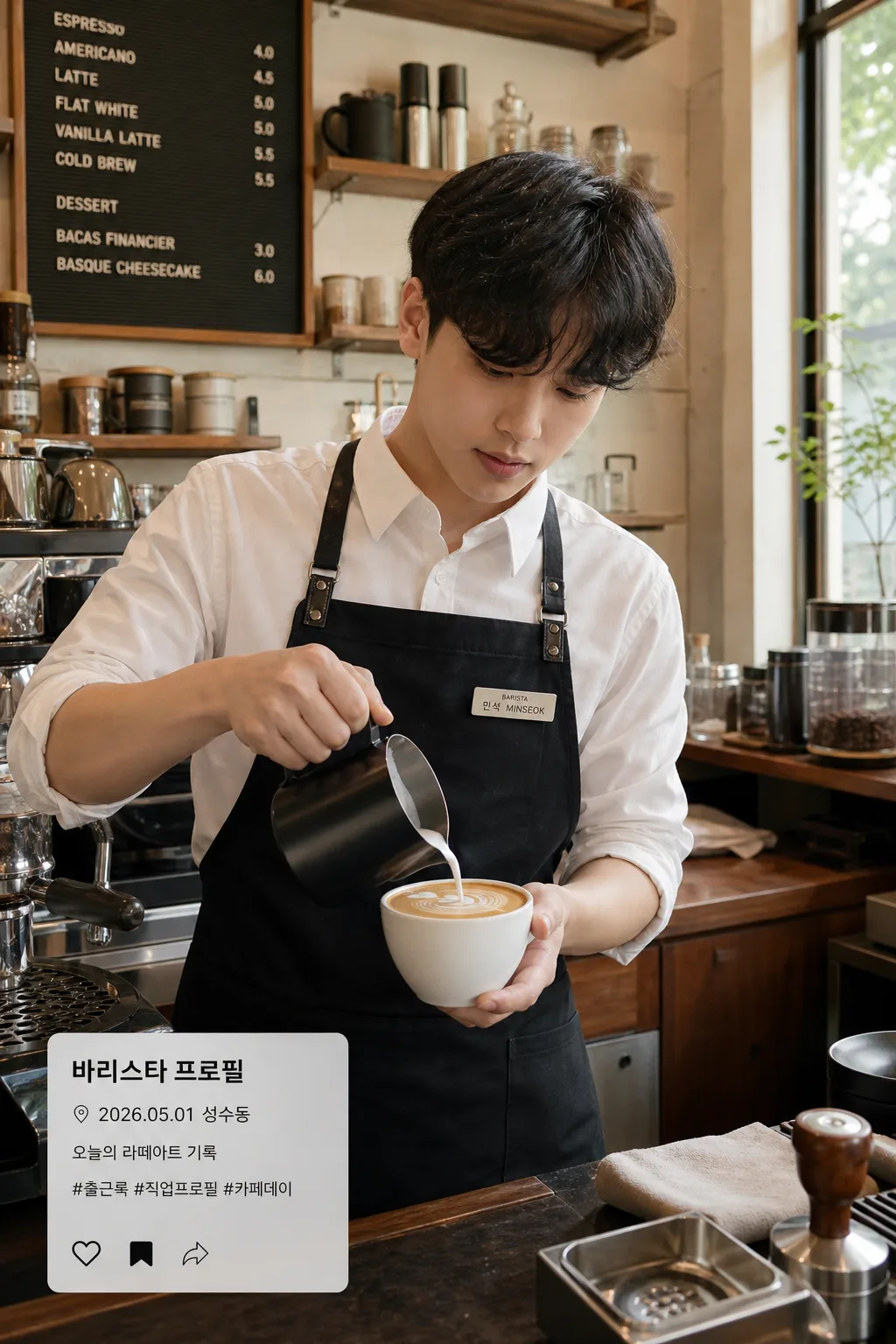
본인 사진 + 다양한 직업 코스튬으로 변환. 바리스타·간호사·승무원·셰프·소방관·경찰·교사·연구원 — 자유 선택.
직업 코스튬 사진 변환 summary
Copy this ChatGPT image prompt to create Profiles/Avatars results. Its subject, background, style, and composition are organized for quick iteration.
Related keywords: 직업 코스튬 사진 변환, 직업 코스튬 사진 변환 프롬프트, Profiles/Avatars 프롬프트, Profiles/Avatars AI 이미지 프롬프트, ChatGPT 이미지 프롬프트, AI 이미지 생성 프롬프트, AI 프롬프트, 이미지 프롬프트
How to use 직업 코스튬 사진 변환
Keep the prompt structure and swap the subject, background, palette, or composition to create new variations.
- Keep the main subject and adjust the palette and background for your brand, season, or channel.
- If the result feels busy, simplify the background and make the subject, composition, and lighting more specific.
- After copying, ask ChatGPT to adapt it for your platform, aspect ratio, or text requirements.
Original prompt
[Input]
- reference_image: {참고 이미지}
- language: Korean
- output_size: 1024x1536

[Purpose]
1-2 English lines: i2i professional costume transformation portrait, photoreal commercial style for social profile / concept art use.
Create a believable occupation-themed makeover while preserving identity and body structure from the source photo, with real workplace atmosphere and a subtle profile-card editorial layer.

[Composition]
- Main subject: the attached person stays the hero, full upper-body to half-body framing with face occupying about 35-40% of frame height.
- Identity preservation: keep {원본 보존} exactly, with no facial reshaping, no body slimming, no age change.
- Costume focus: replace only clothing according to {직업·코스튬}; add believable workwear details such as seams, pockets, name tag, apron strap, badge holder, pen clip, cuff folds, or safety accessory when appropriate.
- Job action: integrate {포즈·자세} so the hands interact with real occupational tools from {직업 소품} in a natural, mid-work moment.
- Background treatment: build a realistic occupational environment based on {배경}, including practical textures, shelves, counters, instruments, documents, machines, trays, cables, wall notices, or soft background signage that would naturally exist in that workplace.
- Editorial profile layer: add a small clean Korean label area using {프로필 라벨}, {날짜·위치}, {캡션}, and {해시태그}; keep it secondary to the portrait, like a modern SNS profile card rather than an advertisement poster.
- Framing direction: subject slightly off-center for a natural editorial feel, with the occupational context visible around hands, torso, and background.
- Use {직업·코스튬}, {배경}, {포즈·자세}, {직업 소품}, {라이팅}, {컬러 톤}, {프로필 라벨}, {날짜·위치}, {캡션}, {해시태그}, {원본 보존} placeholders.

[3. CORE STRUCTURE]
1. Face and body lock-in — preserve the source person’s facial identity, skin texture, hairstyle silhouette, and body proportions from {원본 보존}; keep expression natural and realistic.
2. Wardrobe replacement — apply the occupation outfit from {직업·코스튬} with believable fabric folds, seam details, material thickness, and practical wear marks; avoid costume-party exaggeration.
3. Pose integration — adapt {포즈·자세} so hands interact naturally with {직업 소품}; fingers must remain anatomically correct and gesture flow must match the occupation.
4. Environment build — render {배경} as a real working location with appropriate counters, tools, equipment, posters, notices, shelves, papers, uniforms, instruments, or everyday workplace objects that support the profession.
5. Profile-card details — place {프로필 라벨} as a small top or lower-third identifier, {날짜·위치} as a date/location tag, {캡션} as a short one-line caption, and {해시태그} as subtle social tags; include tiny save/share style micro icons if they fit the layout.
6. Lighting match — follow {라이팅} with physically plausible shadows, consistent highlights on face and clothing, and realistic reflections on metal, glass, ceramic, fabric, or plastic props.
7. Color harmony — apply {컬러 톤} across clothing accents, background materials, tools, label graphics, and secondary objects so the scene feels commercially coherent.
8. Photoreal finish — keep pores, hair strands, cloth texture, dust, paper grain, steam, soft fingerprints on glass, ambient occlusion, and real lens depth visible; maintain a polished commercial-photo finish rather than illustration.

[4. STYLE RULES]
- Typography: use clean Pretendard or Noto Sans KR for the small editorial overlay and any readable workplace labels; medium to semi-bold weight, 22-36px equivalent for tags, 38-54px equivalent for the main profile label.
- Text placement: profile label and caption should sit in a calm lower-third or side tag area; date/location may appear as a small pill label; hashtag text can be compact near the bottom edge.
- Color palette: derive from {컬러 톤}, with realistic neutrals like black, white, gray, navy, wood brown, stainless steel, cream, or mint accents as needed; avoid oversaturated neon unless the chosen profession naturally uses it.
- Graphic accents: use subtle translucent rectangles, thin dividers, tiny dots, save/share micro icons, or small tag stickers; make them feel like a modern mobile profile card overlay integrated with the photograph.
- Shadow and depth: use natural shadows under chin, clothing folds, hands, props, and countertop contact points, with realistic soft edge falloff and practical ambient occlusion.

[5. VISUAL STYLE]
- Camera / lens: Canon EOS R5 with 85mm f/1.4 portrait look, shallow but controlled depth of field, commercial portrait sharpness.
- Lighting: match the environment with soft window light or overhead fluorescent practicals depending on {배경}; keep a clear key-light direction and gentle fill, with realistic specular control on skin, fabric, tools, glass, metal, and laminated surfaces.
- Color grade: photoreal editorial grade with balanced contrast, clean skin tones, and occupation-specific color balance from {컬러 톤}.

[6. MOOD]
Modern commercial portrait transformation — like a high-end LinkedIn headshot campaign meets a realistic TV drama wardrobe change, finished as a stylish Korean SNS profile card.

[7. CRITICAL]
- Korean text accuracy: render all visible Korean text cleanly and exactly, especially {프로필 라벨}, {날짜·위치}, {캡션}, and {해시태그}; examples may read “바리스타 프로필”, “2026.05.01 성수동”, “오늘의 라떼아트 기록”, “#출근룩 #직업프로필”.
- Anatomical/layout invariants: preserve the source person’s identity from {원본 보존}; hands must be anatomically correct with exactly 5 fingers per hand; no extra limbs, duplicate hands, warped wrists, or face distortion.
- Work realism: costume, tools, and background must match the chosen job from {직업·코스튬}; props should look used in a real workplace, not like toy props or stage decorations.
- The result must feel like a real photographed occupational portrait with subtle profile-card design, not a cosplay poster or illustration.

[8. 🚫 PROHIBITED]
- Fake official seals / certifications / government-style authorization marks
- Broken Korean characters or unreadable Hangul
- Unauthorized celebrity composites or duplicated faces
- Extra hands, distorted anatomy, cartoonish props, CG glow, or painterly rendering