Profiles/Avatars
잡지 표지 모델 변환
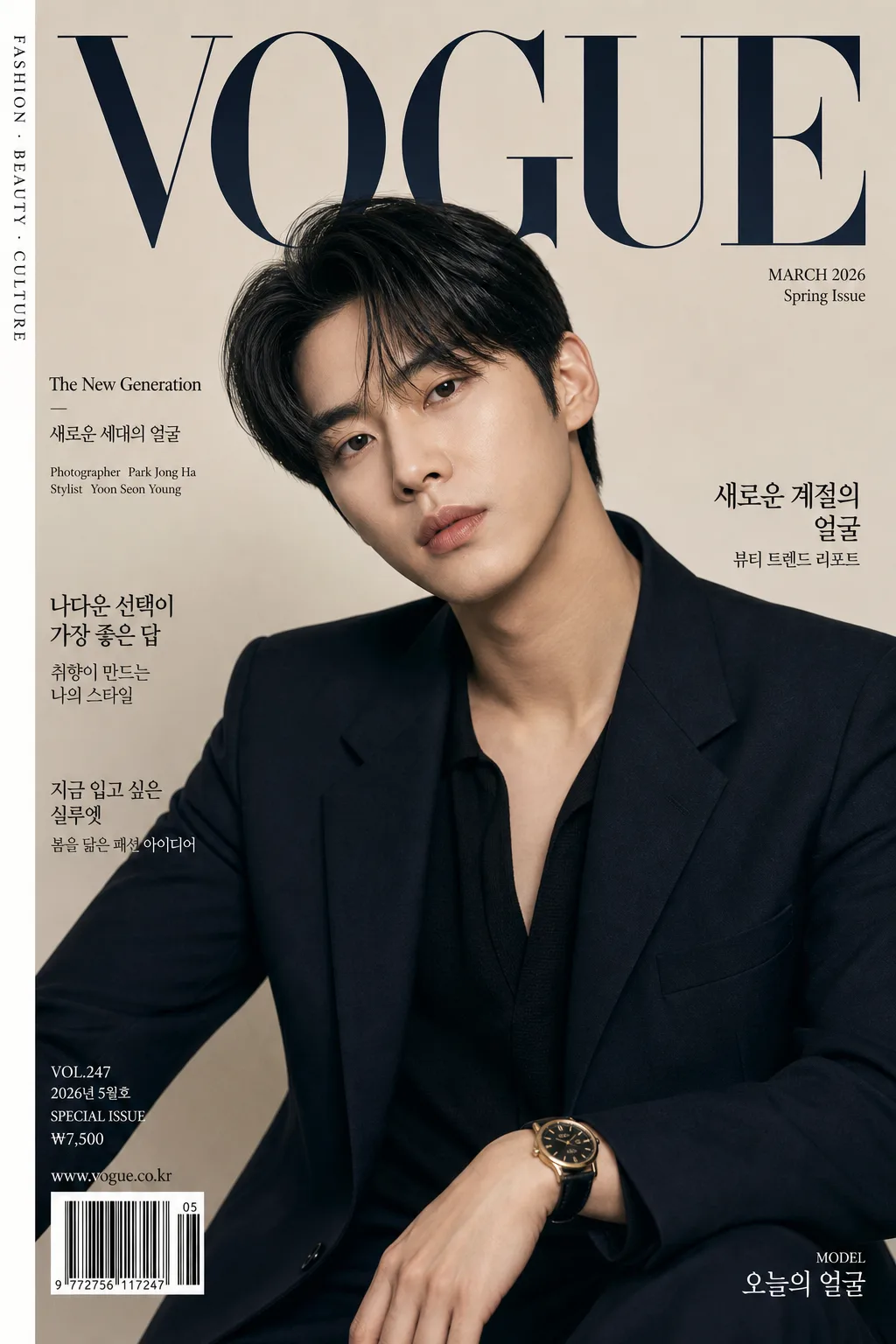
본인 사진 → 글로벌 잡지 표지. Vogue·GQ·Marie Claire·Esquire·Harper's Bazaar 시그니처 톤. 모델 hero + 큰 잡지명 + 부제·크레딧.
잡지 표지 모델 변환 summary
Copy this ChatGPT image prompt to create Profiles/Avatars results. Its subject, background, style, and composition are organized for quick iteration.
Related keywords: 잡지 표지 모델 변환, 잡지 표지 모델 변환 프롬프트, Profiles/Avatars 프롬프트, Profiles/Avatars AI 이미지 프롬프트, ChatGPT 이미지 프롬프트, AI 이미지 생성 프롬프트, AI 프롬프트, 이미지 프롬프트
How to use 잡지 표지 모델 변환
Keep the prompt structure and swap the subject, background, palette, or composition to create new variations.
- Keep the main subject and adjust the palette and background for your brand, season, or channel.
- If the result feels busy, simplify the background and make the subject, composition, and lighting more specific.
- After copying, ask ChatGPT to adapt it for your platform, aspect ratio, or text requirements.
Original prompt
[Input]
- reference_image: {참고 이미지}
- language: Korean
- output_size: 1024x1536

[Purpose]
Create an i2i fashion magazine cover transformation that preserves the attached person’s identity while restyling them into a high-end editorial cover model.
Vertical full-cover layout for Vogue/GQ/Marie Claire/Harper's Bazaar-style print-ready magazine art, enriched with realistic cover furniture: masthead, issue/date label, feature blurbs, barcode area, model credit, small spine text, and editorial production details.

[Composition]
- Main subject: the attached person, identity preserved, placed as a dominant cover hero occupying about 62% of the frame height, with clean facial visibility, confident editorial posture, believable skin texture, and fashion-cover presence.
- Title zone: magazine masthead at the top 12–15% of the page; set {잡지 종류} as the primary cover title with strong hierarchy, partially interacting with hair or shoulders if compositionally natural.
- Editorial cover text system: place {이슈·날짜} as a clear issue/date line near the masthead; place {부제·크레딧} as a refined subtitle/credit stack; add 2–3 short Korean feature blurbs around the left and right sides without covering the face.
- Real cover details: include a small issue number such as “VOL.247”, a date label such as “2026년 5월호”, a barcode/pricing block near the lower-left or lower-right, a small model-name credit line like “MODEL  오늘의 얼굴”, and tiny spine/credit text along one vertical edge.
- Background treatment: {배경 톤} with realistic editorial separation, subtle paper grain, studio backdrop depth, and print-ready tonal control.
- Spacing and framing: design the page like an actual newsstand fashion magazine, balancing masthead, face, shoulders, blurbs, barcode, and credits while keeping the portrait visually dominant.
- Use {원본 보존}, {잡지 종류}, {이슈·날짜}, {부제·크레딧}, {모델 톤}, {배경 톤}, {컬러 톤} as editable variables.

[3. CORE STRUCTURE]
1. Hero portrait area (center 60–65%): transform the attached person into a magazine-cover model while preserving facial identity, bone structure, age appearance, and natural expression; elevate styling to editorial fashion level with polished posture, composed gaze, and refined body language.
2. Wardrobe and grooming layer: apply {모델 톤} with believable fabric detail, premium tailoring, layered accessories if appropriate, clean hair styling, and refined makeup that matches the selected magazine identity.
3. Masthead and top band: place {잡지 종류} as a large, authentic cover title across the top with strong magazine hierarchy; use classic high-fashion masthead scale and let it feel printed into the page rather than pasted on.
4. Issue and subtitle stack: render {이슈·날짜} clearly near the top area and set {부제·크레딧} in a smaller editorial credit style with thin spacing, crisp alignment, and a real cover-credit rhythm.
5. Feature headline blurbs: add 2–3 short Korean cover lines in supporting positions, for example “나다운 선택이 가장 좋은 답”, “지금 입고 싶은 실루엣”, “새로운 계절의 얼굴”; vary size and weight like real magazine teasers.
6. Cover metadata: include small realistic details such as “VOL.247”, “SPECIAL ISSUE”, “₩7,500”, “www.magazine.kr”, a compact barcode area, tiny photographer/stylist credits, and vertical spine text reading “FASHION · BEAUTY · CULTURE”.
7. Background and color system: build the cover around {배경 톤} and tint it using {컬러 톤}, ensuring the subject remains visually separated from the background through contrast, edge light, realistic shadows, and print-like tonal control.
8. Final cover polish: add subtle print realism such as faint paper texture, ink density variation, controlled contrast, page-edge toning, and premium magazine-cover finishing so the image feels like a real fashion editorial cover.

[4. STYLE RULES]
- Typography: use high-fashion magazine typography such as Didot, Bodoni, or modern serif masthead styling for the title; use Pretendard or Noto Sans KR for Korean supporting text; masthead large and bold, subtitle smaller with tight tracking, credits in 9–14 px equivalent.
- Korean cover text: render short, clean Korean lines accurately and naturally, such as “나다운 선택이 가장 좋은 답”, “지금 입고 싶은 실루엣”, “새로운 계절의 얼굴”, “서울에서 만난 오후”, and “스타일의 기준”.
- Color palette: follow {컬러 톤}; for Vogue-style use black #111111, ivory #F4F0E8, cool white #FFFFFF, and sharp contrast accents; for GQ-style use charcoal #1A1A1A, deep gold #B08D57, and warm neutral highlights; for Marie Claire-style use blush #E8C9D3, soft cream #FAF4EF, and muted rose accents.
- Cover furniture: include a believable barcode block, price/date text, issue number, model credit, small production credits, and a few editorial blurbs arranged with professional hierarchy.
- Border/shadow: subtle magazine print realism, slight edge vignette, soft subject shadow 4px y-offset, 14px blur, 12% opacity; avoid heavy drop shadows or sticker-like outlines.

[5. VISUAL STYLE]
- Camera / lens: editorial fashion photography look, shot on a Hasselblad X2D 100C with 80mm f/1.9 lens or Phase One IQ4 with 80–110mm prime, shallow depth separation but realistic facial detail.
- Lighting: studio softbox key light from upper-left at 45°, gentle fill from front-right, faint rim light separating hair and shoulders, clean specular control on skin and fabric.
- Color grade: print editorial grade with magazine-specific toning; Vogue-like high contrast monochrome-neutral polish, GQ-like deep black and gold warmth, Marie Claire-like pastel soft contrast.
- Print finish: realistic paper grain, slight ink texture, subtle halftone softness in large color fields, crisp typography edges, and believable magazine-cover density.

[6. MOOD]
Premium fashion editorial cover — Condé Nast print cover aesthetic with a refined runway-to-magazine transformation feel, like a top-tier seasonal issue photographed for Vogue or Harper's Bazaar and prepared for a real newsstand release.

[7. CRITICAL]
- Korean text accuracy: the following values must appear correctly if shown in the cover design: {잡지 종류}, {이슈·날짜}, {부제·크레딧}.
- Include realistic magazine-cover additions: issue number/date label, barcode/pricing area, 2–3 short Korean feature headline blurbs, tiny spine or credit text, and a model-name credit line.
- Identity preservation: keep the attached person recognizably the same person; do not change face identity, age appearance, or core facial proportions.
- Hair, hands, and clothing must remain anatomically and visually believable; avoid distorted fingers, warped jawlines, or unnatural facial smoothing.
- Cover layout must feel like a real magazine front page, with clear masthead, issue line, subtitle, feature blurbs, barcode, credits, and editorial hierarchy.

[8. 🚫 PROHIBITED]
- Fake official seals / certifications
- Broken Korean characters
- Celebrity composites or unauthorized celebrity likeness
- Overwritten face identity