Comics/Illustration
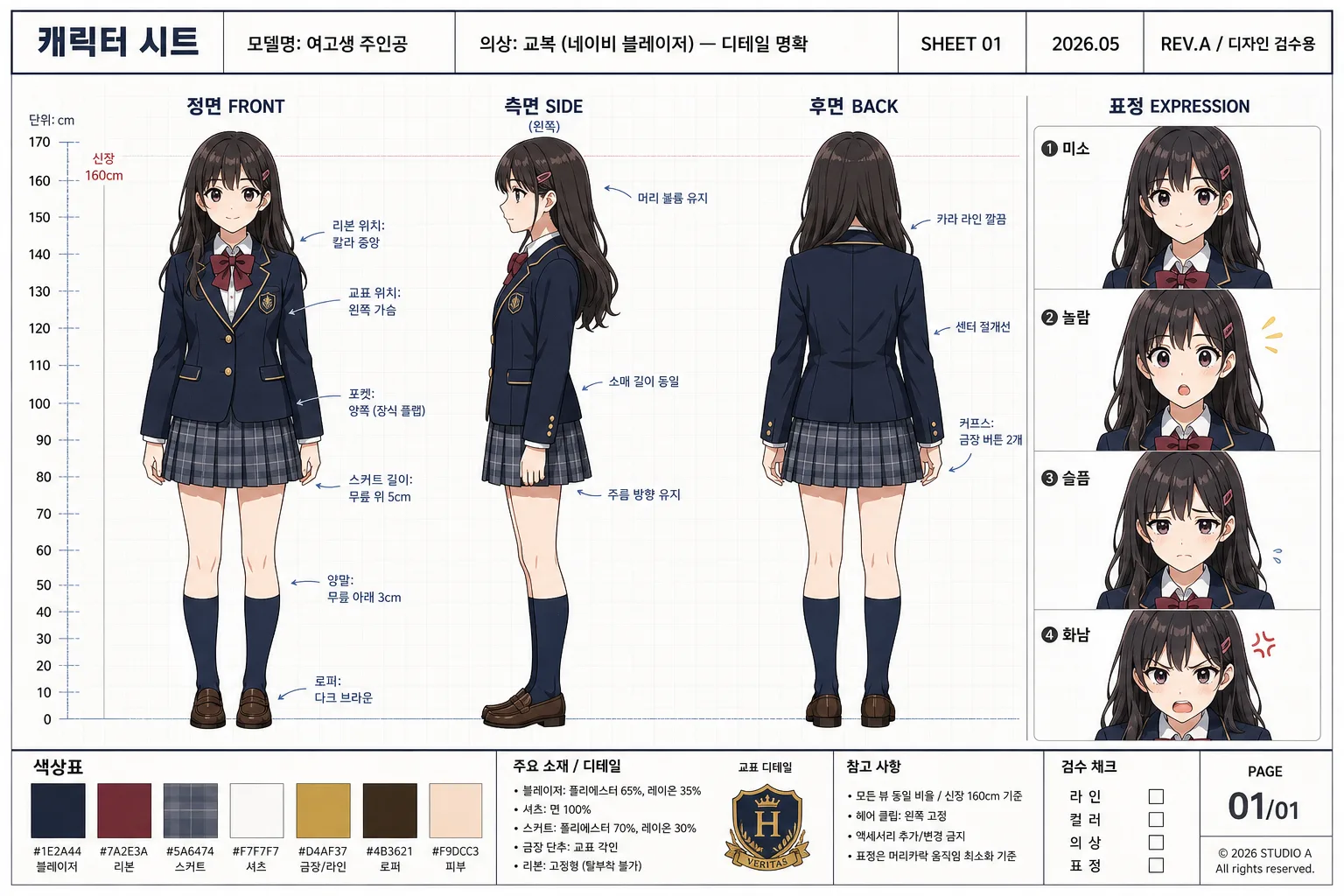
만화 캐릭터 시트 (정면·측면·후면 3 view)
만화 캐릭터 디자인 시트. 정면·측면·후면 3 view + 표정 + 의상.
만화 캐릭터 시트 (정면·측면·후면 3 view) summary
Copy this ChatGPT image prompt to create Comics/Illustration results. Its subject, background, style, and composition are organized for quick iteration.
Related keywords: 만화 캐릭터 시트 (정면·측면·후면 3 view), 만화 캐릭터 시트 (정면·측면·후면 3 view) 프롬프트, Comics/Illustration 프롬프트, Comics/Illustration AI 이미지 프롬프트, ChatGPT 이미지 프롬프트, AI 이미지 생성 프롬프트, AI 프롬프트, 이미지 프롬프트
How to use 만화 캐릭터 시트 (정면·측면·후면 3 view)
Keep the prompt structure and swap the subject, background, palette, or composition to create new variations.
- Keep the main subject and adjust the palette and background for your brand, season, or channel.
- If the result feels busy, simplify the background and make the subject, composition, and lighting more specific.
- After copying, ask ChatGPT to adapt it for your platform, aspect ratio, or text requirements.
Original prompt
[Input]
- language: Korean
- output_size: 1536x1024

[Purpose]
Korean comic character sheet, orthographic 3-view turnaround with expression panel, suited for animation production reference and design approval.
A professional studio model-sheet page with consistent proportions, readable costume construction, Korean production labels, color callouts, measurement guides, and practical annotation details.

[Composition]
- Main 3-view lineup occupies about 72% of the width, arranged left-to-right as front view, left side view, and back view, all at the same scale and standing on the same baseline.
- Expression mini-panel occupies the right 20% of the canvas, separated by a thin production-rule divider and aligned vertically to the center of the main lineup.
- Background is {배경}, presented as a realistic animation reference board surface with subtle paper grain, pale grid ticks, baseline ruler marks, and light guide lines that support the turnaround layout.
- Use {캐릭터} as the central character concept, keeping the face, hairstyle, proportions, and costume consistent across all views.
- Use {3 view} as the structural layout rule, with the same pose and the same body proportions across each view.
- Use {표정 컷} as a compact reference panel with small but clearly legible facial variation.
- Use {의상} as the defining costume language, with seams, trims, accessories, fabric panels, fasteners, pockets, footwear details, and silhouette clearly separated.
- Add a top header strip like a real production sheet: Korean title “캐릭터 시트”, sheet code “SHEET 01”, date label “2026.05”, model credit “모델명: {캐릭터}”, costume credit “의상: {의상}”, and a small artist/revision line “REV.A / 디자인 검수용”.
- Include small technical callouts near the figures, such as fabric color swatches, arrow notes for collar, sleeve, hem, shoes, and accessory placement, without changing the character design.

[3. CORE STRUCTURE]
1. Main front view: place the character on the left third, full body, facing camera directly, neutral stance, arms relaxed, crisp readable silhouette, no perspective distortion. Add the label “정면 FRONT” above or below the figure, plus small height tick marks beside the body.
2. Side view: place immediately to the right of the front view, left-facing profile, matching height and clothing alignment, same hairstyle volume and shoe profile. Add the label “측면 SIDE” and include a small note line for profile details such as “머리 볼륨 유지” or “소매 길이 동일”.
3. Back view: place to the right of the side view, full back view, same pose height and costume construction visible from behind, including collar, hemline, back seams, straps, closures, and back accessories. Add the label “후면 BACK”.
4. Expression panel: place on the right side as a narrow vertical column, showing exactly four small face thumbnails for smile, surprise, sadness, and anger, each with the same head shape and line weight. Label them in Korean as “미소”, “놀람”, “슬픔”, “화남”.
5. Layout separation: use production-sheet dividers, alignment guides, measuring ticks, baseline markers, and small annotation arrows so the page feels like a real design approval board; keep all limbs readable and prevent overlapping between the three main views.
6. Character sheet finish: make the whole page feel like an animation studio turnaround board, with crisp outlines, controlled flat cel colors, light marker-like shading on fabric folds, precise Korean labels, and evenly readable details in every view.
7. Add a compact lower information band containing “색상표”, 5–7 color swatches sampled from {의상} and {배경}, small hex-like labels, page number “01/01”, and a tiny approval checkbox row “라인 / 컬러 / 의상 / 표정”.

[4. STYLE RULES]
- Typography: use Pretendard SemiBold or Noto Sans KR Bold for Korean labels, with smaller Noto Sans KR Regular for notes; dark charcoal text, technical yet editorial, like a Korean animation production packet.
- Color palette: off-white #F7F7F2, charcoal #2B2B2B, soft gray #D9D9D9, muted accent colors from {배경} and {의상}, keeping the palette controlled and animation-sheet friendly.
- Border/shadow: thin light-gray panel lines, 2px separation rules, subtle paper shadow at panel edges, faint blue-gray guide marks, and small printed registration ticks for a believable production-board finish.
- Linework: confident manga-style contour lines with slightly varied stroke weight, clear inner seam lines, visible costume trims, accessory outlines, shoe soles, hair strand groups, and back-view construction details.
- Annotation design: use small arrows, circled detail numbers, swatch chips, and short Korean notes such as “주요 색”, “원단 주름”, “뒤 여밈”, “신발 디테일”; all notes must support the character reference purpose.

[5. VISUAL STYLE]
- Camera / lens: orthographic illustration sheet look, like a clean turnaround board photographed head-on with a 50mm equivalent neutral framing, no dramatic perspective.
- Lighting: even diffuse studio lighting from the front, near-shadowless, with gentle paper texture visible and uniform brightness across all panels.
- Color grade: neutral anime-production palette with soft paper white, restrained saturation, crisp line clarity, and subtle printed-board realism.
- Rendering: polished Korean comic/anime concept-art finish, flat cel base colors with delicate fold shadows, precise edges, and tangible paper-board presentation rather than a sterile mockup.

[6. MOOD]
Anime production character design sheet — polished model-sheet reference board feel, like a real studio turnaround page used for animation approval, with practical Korean labels, revision marks, color chips, and designer notes.

[7. CRITICAL]
- Korean text accuracy: all rendered Korean labels must remain fully legible and free of broken Korean characters, including “캐릭터 시트”, “정면”, “측면”, “후면”, “표정”, “미소”, “놀람”, “슬픔”, “화남”, “색상표”, and “모델명: {캐릭터}”.
- All 3 views must show the same character identity, same costume, same hairstyle, same height proportions, and the same standing pose language.
- The expression panel must contain exactly 4 facial expressions, clearly separated and consistent with the main character design.
- Do not add extra full-body character views beyond front, side, and back; added production details must be labels, swatches, rulers, notes, or sheet graphics only.
- Preserve {캐릭터}, {3 view}, {표정 컷}, {의상}, {배경}, and {비율} exactly as the design inputs shaping the character sheet.

[8. 🚫 PROHIBITED]
- Fake official seals / certifications
- Broken Korean characters