Social/Card News
여행 예산 정산 트래커
여행 지출 트래커 (환율·예산·정산) 카드. 가계부 결.
여행 예산 정산 트래커 summary
Copy this ChatGPT image prompt to create Social/Card News results. Its subject, background, style, and composition are organized for quick iteration.
Related keywords: 여행 예산 정산 트래커, 여행 예산 정산 트래커 프롬프트, Social/Card News 프롬프트, Social/Card News AI 이미지 프롬프트, ChatGPT 이미지 프롬프트, AI 이미지 생성 프롬프트, AI 프롬프트, 이미지 프롬프트
How to use 여행 예산 정산 트래커
Keep the prompt structure and swap the subject, background, palette, or composition to create new variations.
- Keep the main subject and adjust the palette and background for your brand, season, or channel.
- If the result feels busy, simplify the background and make the subject, composition, and lighting more specific.
- After copying, ask ChatGPT to adapt it for your platform, aspect ratio, or text requirements.
Original prompt
[Input]
- language: Korean
- output_size: 1024x1024

[Purpose]
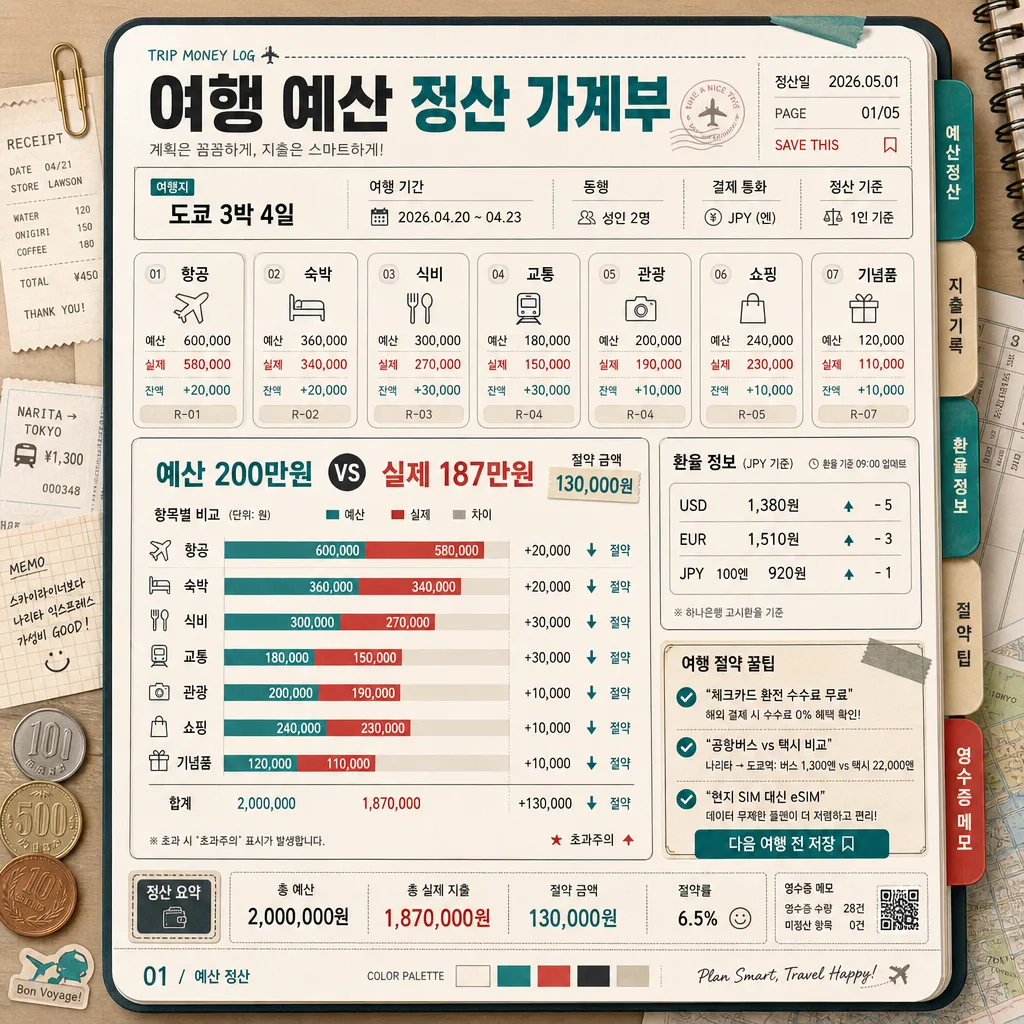
Korean travel budget settlement tracker card, account-book style infographic for trip planning and expense review.
Compact square template for sharing travel spending, budget comparison, exchange rates, daily totals, receipt notes, and money-saving tips in a realistic printed planner/card-news format.

[Composition]
- Centered main tracker panel takes about 84% of the frame, built as a premium square card with rounded corners, subtle paper ledger texture, tab dividers, and a realistic printed account-book feel.
- Header zone occupies the top 14% with a bold title, trip date label, small page indicator, and tiny receipt-style metadata; the lower area is divided into structured budget blocks, a comparison chart, exchange-rate info, tip notes, and a mini settlement summary.
- Use {여행 일정·국가} as the main trip label, {카테고리} as the expense section labels, {예산 vs 실제} as the central comparison module, {환율 정보} as a compact side info box, {절약 팁} as small tip callouts, {컬러 팔레트} for the palette direction, and {비율} for the final canvas framing.
- Background should feel like a real desk-top planner spread: warm off-white ledger paper, faint grid lines, small receipt edges, a tiny paperclip, coin-like travel budget markers, and subtle sticker labels around the card while keeping the tracker information readable.

[3. CORE STRUCTURE]
1. Header area (top 14%): place a strong Korean title in a clean accounting-dashboard style, with a short subtitle line underneath that frames the trip budget theme; add small printed details such as “TRIP MONEY LOG”, “정산일 2026.05.01”, “PAGE 01/05”, and “SAVE THIS”.
2. Trip summary strip: show {여행 일정·국가} as the primary trip context, aligned left in a neat label-value format, like a planner card header; include realistic micro labels such as “여행 기간”, “동행”, “결제 통화”, and “정산 기준”.
3. Category grid: arrange {카테고리} into 7 clearly separated rounded boxes, each with a small line icon placeholder, a tiny spent/remaining label, and a short receipt-code marker such as “R-01”, “R-02”, “R-03” for a real expense-log feel.
4. Budget comparison module: render {예산 vs 실제} as the visual focal point with paired horizontal bars, slim numeric badges, small up/down difference indicators, and tiny labels “예산”, “실제”, “절약”, “초과주의”.
5. Exchange-rate box: place {환율 정보} in a smaller right-side or lower-right callout with a thin border, compact text hierarchy, and a mini timestamp line like “환율 기준 09:00 업데이트”.
6. Savings tips box: stack {절약 팁} as three short checklist-style lines with quote marks preserved, using small tick icons, sticker-note styling, and tight line spacing; add a tiny CTA label “다음 여행 전 저장”.
7. Footer/accent region: use {컬러 팔레트} as a visual guide for the entire card, with printed separators, tiny color swatches, a page indicator “01 / 예산 정산”, a small QR-like decorative block, and a balanced infographic finish based on {비율}.

[4. STYLE RULES]
- Typography: Pretendard or Noto Sans KR for all labels; title in Bold 34–40px, section labels in SemiBold 18–22px, details in Regular 14–16px, with crisp accounting-sheet spacing and realistic printed microcopy.
- Color palette: ivory #F6F1E8, teal #2E8C8C, red accent #D94B45, charcoal #2F343A, plus warm gray #D8D2C8 for dividers and box fills.
- Border/shadow: 1.5px charcoal outline on key cards, soft drop shadow 0px 6px 18px rgba(47,52,58,0.10), very subtle inner highlight for a printed planner look.
- Add realistic editorial details: perforated receipt lines, small tab stickers, ledger row numbers, thin dividers, tiny icon labels, and restrained printed texture that makes the tracker feel physically designed rather than sterile.

[5. VISUAL STYLE]
- Camera / lens: top-down flat lay look, Canon EOS R5 with 50mm lens at f/5.6, minimal perspective distortion, designed like a clean editorial infographic capture.
- Lighting: even studio softbox lighting from upper-left with a faint fill from lower-right, natural soft shadows under paper edges and small desk objects, paper texture visible but restrained.
- Color grade: warm ivory base with controlled teal and red accents, slightly desaturated charcoal text, crisp but not glossy.

[6. MOOD]
Practical editorial planner — like a premium personal finance spread from Monocle with the clean structure of a modern Notion template, enriched by real travel receipt details, saved-note stickers, and friendly Korean budget-tracking microcopy.

[7. CRITICAL]
- Korean text accuracy: the image must correctly include these exact Korean strings, with no broken characters: "여행 일정·국가", "항공·숙박·식비·교통·관광·쇼핑·기념품 — 7박스", "예산 200만원 vs 실제 187만원 / 항목별 막대 그래프", "USD 1,380원 / EUR 1,510원 / JPY 100엔 920원 — 작은 환율박스", "\"체크카드 환전 수수료 무료\" / \"공항버스 vs 택시 비교\" / \"현지 SIM 대신 eSIM\"".
- Also include realistic Korean tracker labels where space allows: "여행 예산 정산 트래커", "정산일 2026.05.01", "PAGE 01/05", "이번 여행 13만원 절약", "영수증 확인", "다음 여행 전 저장".
- All category boxes must remain clearly separated and readable, with consistent spacing and aligned edges across the grid.
- Keep the overall composition square and structured like a budget tracker card, not a travel poster or photo collage.

[8. 🚫 PROHIBITED]
- Fake official seals / certifications
- Broken Korean characters
- Unauthorized celebrity likenesses