취미/라이프
한국 명소 에디토리얼 풍경 사진
한국 지역별 명소 풍경 에디토리얼. 제주/부산/경주 등 자유 입력. 여행 매거진·블로그 헤더용.
한국 명소 에디토리얼 풍경 사진 검색 요약
한국 명소 에디토리얼 풍경 사진은 취미/라이프 결과물을 만들 때 바로 복사해 활용할 수 있는 ChatGPT 이미지 프롬프트입니다. 주제, 배경, 스타일, 구도 조건을 함께 담아 빠르게 시안을 만들 수 있도록 구성했습니다.
관련 키워드: 한국 명소 에디토리얼 풍경 사진, 한국 명소 에디토리얼 풍경 사진 프롬프트, 취미/라이프 프롬프트, 취미/라이프 AI 이미지 프롬프트, ChatGPT 이미지 프롬프트, AI 이미지 생성 프롬프트, AI 프롬프트, 이미지 프롬프트
한국 명소 에디토리얼 풍경 사진 활용 포인트
원본 구조를 유지하면서 피사체, 배경, 색감, 구도를 바꿔 다양한 시안으로 확장할 수 있습니다.
- 핵심 소재는 유지하고 브랜드, 계절, 채널 목적에 맞는 색감과 배경을 바꿔보세요.
- 결과가 산만하면 배경 요소를 줄이고 피사체, 구도, 조명 조건을 구체화하세요.
- 복사한 뒤 ChatGPT에서 플랫폼, 화면 비율, 텍스트 포함 여부를 추가로 요청할 수 있습니다.
프롬프트 원문
[Input]
- language: Korean
- output_size: 1024x1536

[Purpose]
Korean travel magazine editorial landscape photograph, portrait-oriented scenic cover feature for social media and print-style editorial use.
Showcase a famous Korean destination with a cinematic, photo-realistic atmosphere, real magazine-cover context, and a strong sense of place.

[Composition]
- Main subject: {장소} as the clear focal point, with the strongest visual interest placed across the middle and lower thirds.
- Frame structure: {구도} with a polished vertical cover layout that allows the landmark, coastline, mountain, street, or vista to remain instantly readable.
- Background treatment: distant horizon, atmospheric depth, and natural texture in water, sand, rock, trees, street surfaces, rooftops, or sky depending on {장소}.
- Time and atmosphere: {시간대} to define the color of the sky, reflections, shadow length, and realistic local weather texture.
- Mood layer: {무드} carried through spacing, contrast, horizon placement, human scale, and the rhythm of natural details.
- Regional context: {지역} should be readable as the visual identity of the scene through architecture, coastline, terrain, vegetation, local walking paths, seasonal details, or small authentic travel cues.
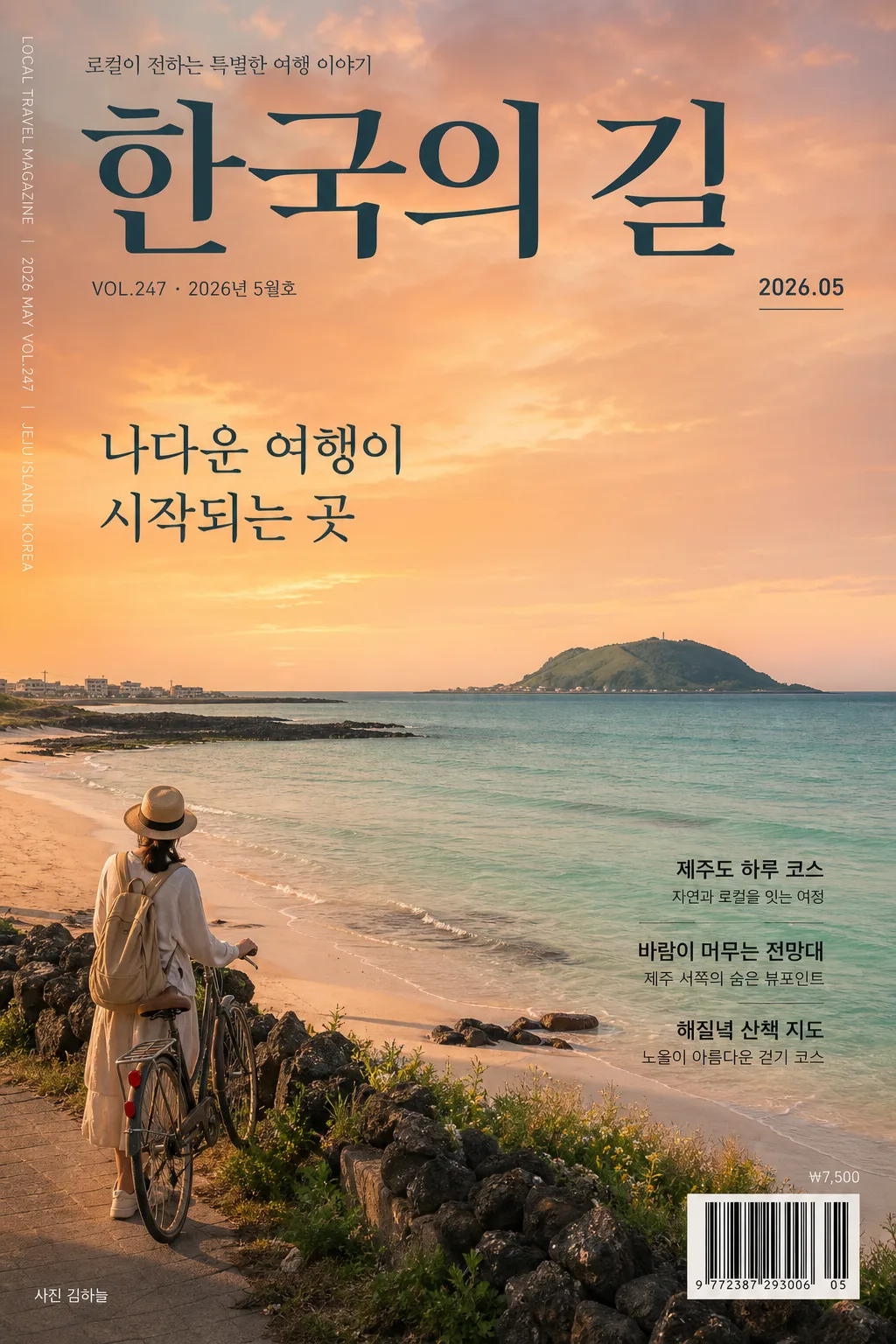
- Editorial cover context: include a refined Korean travel magazine masthead and cover typography integrated over the photograph, with issue information, short feature blurbs, barcode area, and small credit text.

[3. CORE STRUCTURE]
- Hero landscape area: {장소} occupies most of the frame with a premium scenic read; keep the primary landmark, shoreline, vista, street, or natural formation sharply legible.
- Cover masthead zone: place a large Korean magazine title near the top, such as “한국의 길” or “로컬 트래블”, with small issue text “VOL.247 · 2026년 5월호” and a date label “2026.05”.
- Feature headline zone: add one strong Korean cover line over a visually calm part of the sky or darker land area: “나다운 여행이 시작되는 곳”.
- Supporting blurbs: add 2–3 short Korean editorial teasers placed along the side or lower third, such as “{지역} 하루 코스”, “바람이 머무는 전망대”, “해질녘 산책 지도”.
- Magazine details: include a small vertical spine/credit text near one edge, a discreet barcode box in the lower corner, tiny price text “₩7,500”, and photo credit “사진 김하늘”.
- Secondary detail zone: include a small human presence, backpack, camera strap, bicycle, ferry rail, café chair, trail marker, or travel object only if it fits naturally into {구도}, scaled modestly so the landscape remains dominant.
- Sky and light zone: {시간대} creates a layered sky gradient, soft edge highlights, and subtle reflective color on sea, river, terrain, glass, stone, or sand.
- Spatial depth: foreground texture, midground focal area, and distant background should be clearly separated to create a premium editorial travel-photo feel.
- Emotional tone: {무드} should come from the scale of the view, the lived-in travel details, natural weather, and gentle sunset color transition.

[4. STYLE RULES]
- Typography: Korean magazine-cover typography should feel professionally typeset and printed on top of the photograph; use crisp Hangul, high contrast, elegant hierarchy, and realistic editorial alignment.
- Korean text to render in image: “한국의 길”, “VOL.247”, “2026년 5월호”, “나다운 여행이 시작되는 곳”, “{지역} 하루 코스”, “바람이 머무는 전망대”, “해질녘 산책 지도”, “사진 김하늘”, “₩7,500”.
- Color palette: warm sunset palette with orange-pink sky, sea-glass emerald, soft sand beige, and muted slate shadows; if needed, refine with #F6D2B8, #F3E7D3, #6FC7B8, #2F4A57.
- Graphic treatment: magazine elements should sit naturally on the photograph with subtle print-like opacity, clean alignment, and realistic contrast against sky, water, stone, or shadowed terrain.
- Environmental realism: include location-appropriate textures such as rippled water, wind-shaped grass, stone steps, coastal railings, distant boats, tiled roofs, pine silhouettes, tide marks, footprints, mist, or warm window lights where appropriate to {장소}.

[5. VISUAL STYLE]
- Camera / lens: full-frame landscape shot, 24mm wide-angle lens at f/8, crisp editorial detail with deep scenic clarity.
- Lighting: golden hour sunset light from the low horizon, soft side illumination with gentle atmospheric haze and mild reflective fill from water or sand.
- Color grade: slight HDR processing with controlled highlights, warm cream + orange-pink sunset tones, and clean emerald blues kept natural rather than oversaturated.
- Material fidelity: printed cover typography, barcode, and small editorial details should appear sharp and believable while the underlying photograph remains the dominant photorealistic scene.

[6. MOOD]
Korean travel magazine editorial scenic cover — like a refined National Geographic Traveler cover story with calm Kinfolk-like pacing, but richer with authentic destination details, small travel cues, and polished Korean magazine design.

[7. CRITICAL]
- Korean text accuracy: all visible Korean text must be clean, readable Hangul with no garbled characters; prioritize these exact strings: “한국의 길”, “VOL.247”, “2026년 5월호”, “나다운 여행이 시작되는 곳”, “{지역} 하루 코스”, “사진 김하늘”.
- Composition invariant: portrait framing must preserve a wide scenic read, with the landscape remaining the dominant subject and any human/object accent staying small.
- Photorealism: water, sky, sand, stone, vegetation, architecture, and distant landforms must look physically believable with no surreal distortions.
- Editorial realism: cover lines, barcode, issue number, date label, and credit text should look like a real Korean travel magazine cover, not a blank poster mockup.

[8. 🚫 PROHIBITED]
- Broken Korean characters
- Fake official seals / certifications