廣告/海報
3D 음식 렌더 (스시·피자·디저트)
3D 음식 미니어처. 매크로 + 부드러운 광택.
3D 음식 렌더 (스시·피자·디저트)摘要
這是用來製作廣告/海報內容的 ChatGPT 圖像提示詞,已整理主題、背景、風格與構圖,方便快速調整。
相關關鍵字: 3D 음식 렌더 (스시·피자·디저트), 3D 음식 렌더 (스시·피자·디저트) 프롬프트, 廣告/海報 프롬프트, 廣告/海報 AI 이미지 프롬프트, ChatGPT 이미지 프롬프트, AI 이미지 생성 프롬프트, AI 프롬프트, 이미지 프롬프트
3D 음식 렌더 (스시·피자·디저트)使用方式
保留原始結構並替換主體、背景、色彩或構圖,即可延伸出不同版本。
- 保留核心主體,並依品牌、季節或平台調整色彩與背景。
- 如果畫面太複雜,請減少背景元素並具體描述主體、構圖與光線。
- 複製後可要求 ChatGPT 配合平台、長寬比或文字需求調整。
提示詞原文
[Input]
- language: Korean
- output_size: 1024x1024

[Purpose]
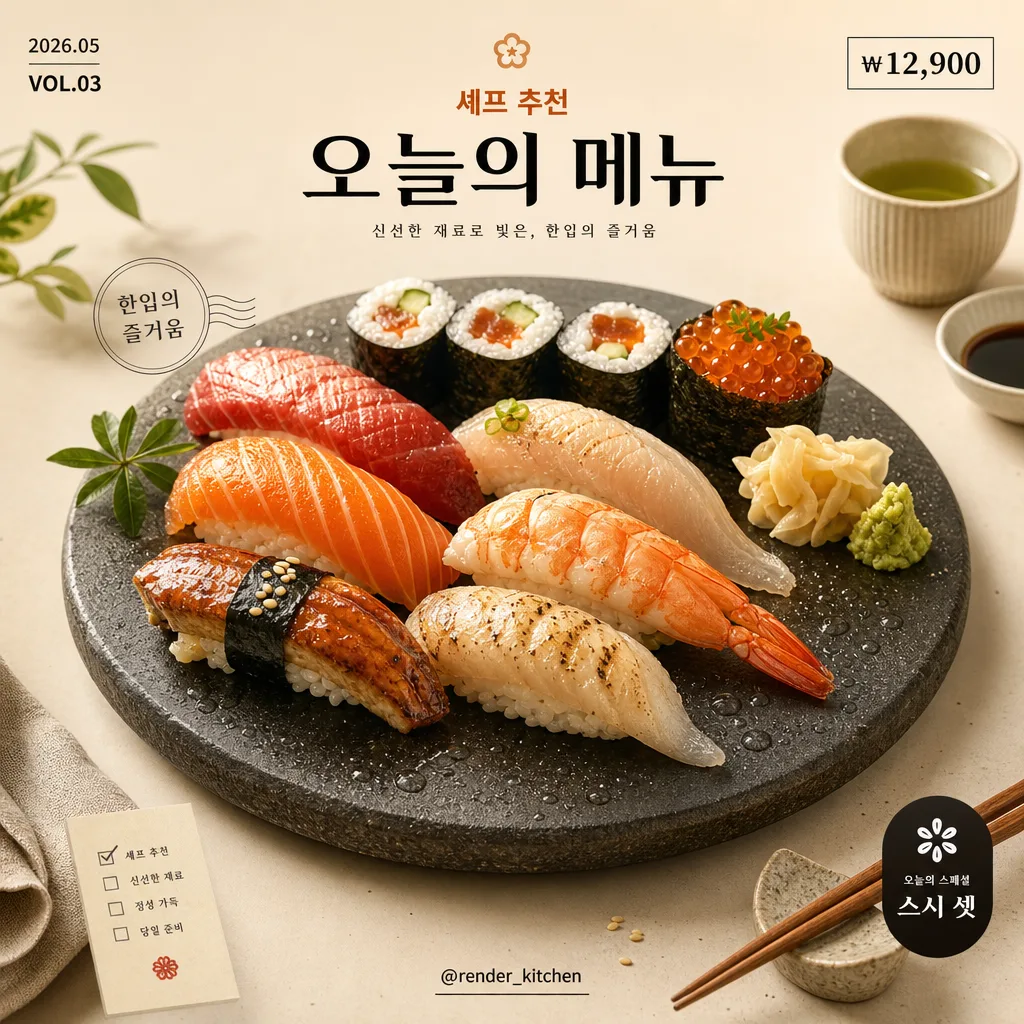
3D food render poster for social media and portfolio use, with a polished magazine-food aesthetic that can swap between sushi, pizza, dessert, ramen, chicken, or fruit.
Render the food as an appetizing hero object with miniature stylization, combining realistic surface detail, clay-like softness, and a lived-in premium tabletop scene suitable for a square editorial menu post.

[Composition]
- Main subject placement: {음식} occupies the central 62% of the frame as the hero, slightly lifted above the ground plane or plated on a low dish so the cast shadow is visible and readable.
- Background treatment: {배경} as a tactile studio tabletop scene with believable surface texture, gentle color variation, and food-appropriate context such as a ceramic plate, parchment sheet, lacquer tray, linen napkin, sauce dish, crumbs, herbs, sesame, fruit slices, or steam accents depending on {음식}.
- Framing and spacing: keep the hero food dominant in a square poster layout, with supporting details arranged around it to create a realistic editorial food set rather than an empty product mockup.
- Surface treatment: place the subject on a premium tabletop, plate, tray, or small plinth with realistic contact shadows, tiny crumbs, glaze marks, sauce streaks, moisture beads, or powder dusting where appropriate.
- Poster information layer: add small editorial menu-poster details around the food, including a top date label, short Korean title line, tiny price or volume tag, and a small social handle, integrated as tasteful printed or overlay typography.

[3. CORE STRUCTURE]
- Hero object (center 62%): {음식} modeled as a refined 3D food render with glossy highlights, tiny texture imperfections, appetizing volume, clean edge definition, and visible ingredient layering; keep the form stylized but rich enough to feel like premium food advertising.
- Material pass: apply {결} to the food surface, mixing soft specular reflections with micro-detail such as toasted edges, rice grain definition, melted cheese pull texture, cream swirls, fruit gel shine, crispy crust pores, sauce thickness, or powder granules as appropriate to {음식}.
- Base environment: build the scene around {배경} with layered tabletop objects that naturally belong with the food: a plate or tray, small garnish pieces, crumbs, sauce droplets, folded napkin, chopsticks, fork, cup, menu slip, or small ingredient fragments, all scaled to support the hero food.
- Light behavior: shape the scene with {조명} so the shadow falls softly and the highlights wrap naturally around the food, emphasizing rounded forms, moist surfaces, crispy textures, and dimensional 3D depth.
- Color emphasis: guide the palette using {컬러 톤}, ensuring the food remains the highest-contrast element while the surrounding props, tabletop, and typography harmonize with the same palette.
- Format control: maintain a square composition using {비율}, with the subject centered, fully readable, and supported by balanced editorial details around the frame.
- Micro text elements: include short Korean poster copy such as "오늘의 메뉴", "셰프 추천", "한입의 즐거움", "₩12,900", "VOL.03", "2026.05", and "@render_kitchen"; keep text small-to-medium except for one clear headline.

[4. STYLE RULES]
- Typography: use Pretendard SemiBold or Noto Sans KR Medium for visible Korean food-poster typography. Set one bold Korean title near the lower or upper third, such as "오늘의 메뉴" or "셰프 추천 {음식}", plus smaller support text like "2026.05", "VOL.03", "₩12,900", and "@render_kitchen".
- Color palette: use food-specific signature colors from {컬러 톤}, supported by tactile neutrals such as warm ceramic, muted pastel paper, wood grain, stone, brushed metal, linen, or charcoal depending on {배경}; allow vivid food color accents where appetizing.
- Border/shadow: use a soft drop shadow with 4px y-offset, 14px blur, and 16% opacity for the main object or typography accents; avoid harsh outlines while allowing subtle printed-poster depth, small labels, decorative dividers, and soft graphic shapes.
- Decorative graphic system: add small editorial elements such as thin divider lines, a circular price tag, tiny corner index marks, ingredient icon dots, or a small menu-card strip; these should feel like a designed social food poster, not a sterile catalog render.
- Texture realism: preserve visible texture in the food and set dressing, including glaze, crumbs, grains, bubbles, char marks, sauce sheen, condensation, ceramic speckles, paper fibers, or wooden pores where relevant.

[5. VISUAL STYLE]
- Camera / lens: studio product photography look, equivalent to a 85mm macro-style lens at f/8 for crisp food detail and shallow scene clutter.
- Lighting: soft diffused natural light with a warm amber fill, key light from upper-left at about 45°, subtle rim light from upper-right, and gentle shadow falloff.
- Color grade: premium editorial food grade with clean neutrals, warm highlights, and slightly enriched food tones; keep the background supportive while allowing tactile props, typography, and garnish details to make the poster feel real and content-rich.
- Render quality: physically based 3D render with global illumination, realistic subsurface hints for soft ingredients, believable roughness variation, high-resolution texture maps, and gentle ambient occlusion in contact areas.

[6. MOOD]
Premium 3D food editorial — like a high-end Blender food render for a boutique café menu campaign, with playful miniature realism, appetizing surface detail, warm studio lighting, and designed Korean social-poster information.

[7. CRITICAL]
- Korean text accuracy: render all on-image Korean text cleanly and legibly. Recommended text strings include "오늘의 메뉴", "셰프 추천", "한입의 즐거움", "신선한 재료", "₩12,900", "2026.05", "VOL.03", and "@render_kitchen".
- Composition invariant: keep the main food subject centered, dominant, and fully readable in a square frame while surrounding it with believable food styling, tabletop texture, and small editorial menu details.
- Style invariant: preserve the 3D food render look with a mix of realistic detail and clay-like softness; do not turn it into flat illustration or photographic real food.
- Content richness: include food-appropriate contextual details such as garnish, sauce, crumbs, steam, utensils, dishware, napkin, menu label, or ingredient fragments when they naturally match {음식}.

[8. 🚫 PROHIBITED]
- Fake official seals / certifications
- Broken Korean characters
- Celebrity composites / unauthorized likeness