Comics/Illustration
보태닉 일러 아트 (식물·꽃 컬렉션)
보태닉 일러 아트. 식물 컬렉션 결.
보태닉 일러 아트 (식물·꽃 컬렉션) summary
Copy this ChatGPT image prompt to create Comics/Illustration results. Its subject, background, style, and composition are organized for quick iteration.
Related keywords: 보태닉 일러 아트 (식물·꽃 컬렉션), 보태닉 일러 아트 (식물·꽃 컬렉션) 프롬프트, Comics/Illustration 프롬프트, Comics/Illustration AI 이미지 프롬프트, ChatGPT 이미지 프롬프트, AI 이미지 생성 프롬프트, AI 프롬프트, 이미지 프롬프트
How to use 보태닉 일러 아트 (식물·꽃 컬렉션)
Keep the prompt structure and swap the subject, background, palette, or composition to create new variations.
- Keep the main subject and adjust the palette and background for your brand, season, or channel.
- If the result feels busy, simplify the background and make the subject, composition, and lighting more specific.
- After copying, ask ChatGPT to adapt it for your platform, aspect ratio, or text requirements.
Original prompt
[Input]
- language: Korean
- output_size: 1024x1536

[Purpose]
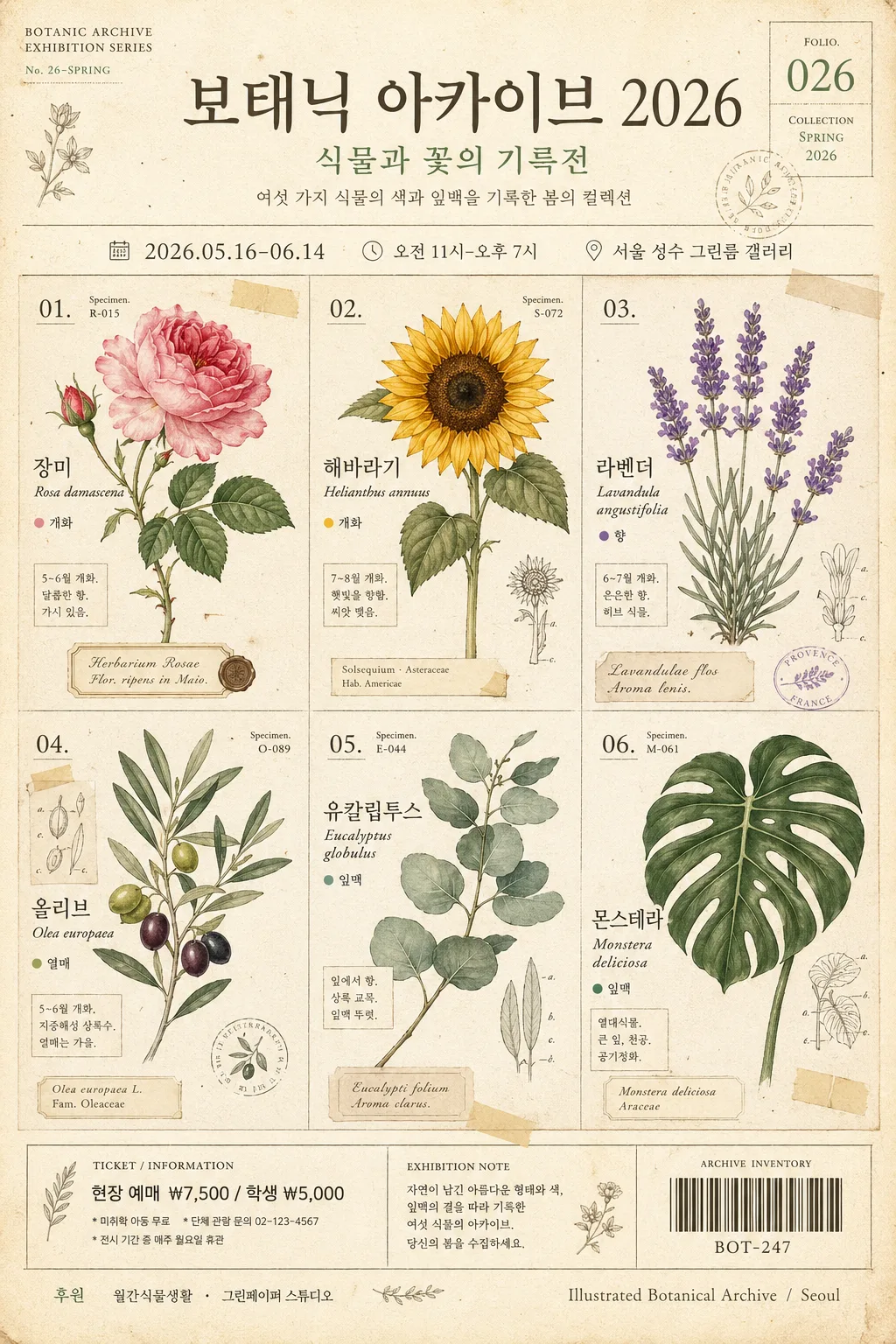
보태닉 일러스트 포스터 / 식물·꽃 컬렉션 편집 디자인. 2x3 grid or free collage layout for editorial wall art, printable poster, botanical exhibition poster, and social-media share.

[Composition]
- Overall framing: a tall 1024x1536 vertical poster with {레이아웃} as the main structure, designed like a vintage botanical art exhibition sheet with editorial poster information integrated into the artwork.
- Subject placement: six botanical illustrations distributed across the page with clear visual hierarchy; larger focal blooms near the upper-left and lower-right, smaller leaf specimens woven between labels, captions, date blocks, and decorative specimen marks.
- Background treatment: warm cream-beige paper texture with visible fibrous grain, light archival stains, faint print speckles, and subtle pressed-flower shadows that make the poster feel physically printed.
- Poster information layer: include the exhibition title “{전시명}”, date “{행사일정}”, time “{행사시간}”, venue “{장소}”, ticket line “{티켓정보}”, and a small sponsor/archive area “{후원문구}”.
- Editorial details: add specimen numbers, Latin-style plant names, Korean plant labels, page-like folio marks, a small barcode-style inventory mark, and delicate botanical diagram lines without overwhelming the six featured plants.
- Apply {결} as the underlying art direction, and keep {결_추가} influence visible through magazine-like section labels, herbarium annotations, and refined printed finishing.

[3. CORE STRUCTURE]
1. Canvas base — set an off-white cream paper field with faint natural fiber texture, lightly aged edges, tiny ink flecks, and a scanned archival herbarium-sheet feeling.
2. Primary botanical set — place {식물목록} as six distinct illustrated subjects, each with nearby Korean name, Latin-inspired caption, specimen number, and one small descriptive note such as “개화”, “향”, or “잎맥”.
3. Layout system — arrange the six pieces according to {레이아웃}: either a structured 2x3 grid with editorial gutters or a loose collage with slight rotation, overlapping stems, label stickers, thin guide lines, and herbarium tape details while keeping all six plants readable.
4. Poster title block — position “{전시명}” prominently near the upper area, with a smaller subtitle “식물과 꽃의 기록전” and the short curator note “{소개문구}”.
5. Event detail block — place “{행사일정} · {행사시간} · {장소}” in a neat information band; add “{티켓정보}” as a ticket/call-to-action line near the lower third or bottom.
6. Sponsor and archive strip — include “{후원문구}”, a small barcode-style code “BOT-{포스터번호}”, and a printed credit line “Illustrated Botanical Archive / Seoul” near the bottom edge.
7. Color handling — render all flora using {컬러} as the governing palette, with soft watercolor washes, ink outlines, muted shadowing, pressed-petal stains, and restrained vintage print contrast.
8. Typography layer — apply {타이포} as delicate label text near each plant, resembling vintage botanical specimen tags with Korean lettering, Latin serif captions, and small event typography.
9. Finishing pass — add fine rule lines, tiny decorative flower icons, specimen arrows, transparent washi-tape corners, and subtle overprint texture inspired by {결_추가}.

[4. STYLE RULES]
- Typography: use Pretendard or Noto Sans KR for Korean labels and event details, paired with a thin Latin serif such as Cormorant Garamond or Baskerville; use readable hierarchy with 18–28 px specimen labels, 34–52 px poster title, and smaller 12–16 px archive notes.
- Rendered Korean text examples in the poster: “{전시명}”, “식물과 꽃의 기록전”, “{행사일정}”, “{행사시간}”, “{장소}”, “{티켓정보}”, “{후원문구}”, “장미 Rosa”, “라벤더 Lavender”, “올리브 Olive”.
- Color palette: {컬러} should resolve into botanical greens, floral signature accents, warm cream beige, aged ink brown, and softened leaf-shadow gray; recommend tones like #EDE4D1, #7C9B74, #D98C8C, #C9B07A, #5E6F58, and #6D5A45.
- Border/shadow: use a printed poster edge, fine hairline rules, pinned-paper shadows, and soft herbarium tape overlays; shadows should feel like physical paper layers photographed in daylight.
- Decorative graphics: include tiny seed diagrams, leaf cross-section icons, dotted measuring ticks, archival catalog numbers, and small floral corner ornaments that match the botanical theme.

[5. VISUAL STYLE]
- Camera / lens: editorial flat-lay look, equivalent to a top-down 50mm lens perspective with no perspective distortion, as if photographed for a modern herbarium catalog.
- Lighting: even diffused daylight from upper-left, soft fill from right, gentle paper-layer shadows, visible watercolor pigment blooms, ink texture, and cream paper grain throughout.
- Color grade: muted natural greens, dusty petal tones, warm cream paper, slightly desaturated vintage print contrast, and a tactile museum-shop poster finish.

[6. MOOD]
Vintage botanical magazine spread meets small gallery exhibition poster — poetic, collectible, archival, and handmade, like a refined museum catalog plate printed for a spring botanical art fair.

[7. CRITICAL]
- Korean text accuracy: the rendered image must preserve clean, correct Korean lettering wherever labels, event details, and captions appear; no broken characters, no missing glyphs.
- Must visually communicate six botanical subjects in one cohesive collection page: “장미”, “해바라기”, “라벤더”, “올리브”, “유칼립투스”, “몬스테라”.
- Required visible Korean poster text: “{전시명}”, “{행사일정}”, “{행사시간}”, “{장소}”, “{티켓정보}”, “{후원문구}”.
- Labels should remain elegant and legible, with botanical illustration details, specimen numbers, and archive-style captions supporting the poster rather than hiding the plants.

[8. 🚫 PROHIBITED]
- Fake official seals / certifications
- Broken Korean characters or garbled botanical labels
- Celebrity composites / real-person likeness insertion
- AI-smooth plastic rendering that removes watercolor, ink, and paper texture